Tel: +86-532-83130887 Email: eiffel@qdhaijia.net



| Quantity: | |
|---|---|
HW-6012
Haijia
84463040
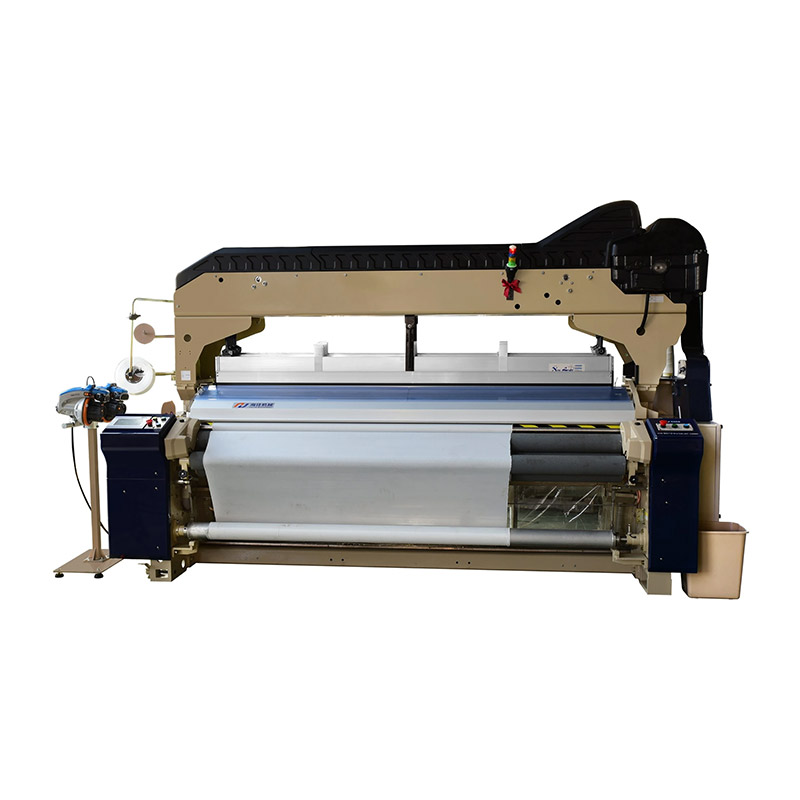
The HW-6012 series water jet weaving machine is engineered with an extensively strengthened fuselage, providing a highly stable foundation for continuous textile production. By integrating multi-layered reinforcement beams, the structural integrity minimizes operational vibration, ensuring a quiet and precise weaving process even during intensive shifts.
Operators will find this model exceptionally adaptable to the weaving of most fabrics. It is specifically calibrated to handle the intricate demands of fine denier and high-density materials, such as chiffon, georgette, four-sided elastic, nylon taffeta, spandex, and specialized down jacket fabrics.
This series has also been greatly improved in terms of waterproofing, utilizing advanced sealing techniques that protect core mechanical components from moisture exposure. It can be widely used in the weaving of various fabrics under demanding conditions. The maximum speed can reach 1000RPM, delivering rapid output without compromising thread integrity.
Taking 75D fabric as an example, the highest weft density is 80 shuttles/cm (205 threads per inch), resulting in a tight, uniform textile structure with an excellent tactile finish.
The reinforced integrated machine wall board is made by one complete casting which highly improves the frame rigidity and reduces the vibration and noise pollution. Processed with top-tier Japanese machine tools for exact precision, the metal surfaces undergo an advanced electrophoretic spraying process, giving the cast iron a smooth, rust-resistant finish that extends the machine's lifespan beyond 13 years. Connected with cross beams and middle supporting beam, the re-designed two machine wall boards are firmly jointed together in 20mm lower height which is more suitable for machine operators to manage and inspect daily.
The total tension of the warp is detected by the tension sensor. The CPU handles the change of the warp tension caused by the opening or the change of the loose warp, let off warp and the winding diameter of the warp shaft, and commands the servo motor to drive the warp shaft. This automated intelligence helps to maintain the balanced tension during the working process, eliminate the loose and dense gear, and ensure the stability of the fabric tension, significantly reducing fabric defects.
In order to reduce weaving costs and better protect the environment, splash proof "U" nozzles are widely used. Compared with ordinary nozzles, splash proof "U" nozzles have better water line bunching performance, ensuring a concentrated and forceful spray. Plunger with smaller diameter is used to achieve stable operation under small opening weft insertion and small water volume. A single loom can save 10% water, and the setup fully supports a 100% water circulation treatment system, which is widely applicable to weaving fine denier, high-density and high-speed fabrics.
The optimized beating-up system achieves shorter stroke with low vibration which is designed in modern style on the basis of motion analysis and dynamic equilibrium analysis. The independent developed U type solid beating shaft and beating shaft counter balance system can be used for both narrow machine and wide machine. The small stroke 4-linkage beating system is widely acknowledged for narrow machines while 6-linkage beating system with longer relative static time and stronger beating force provides the best choice for wide machines to make wide and high density fabrics.
Using motorized spindle with no brake disc, which saves more than 20% electricity, reducing long-term operational overhead. By working with the new optimized control system, the stepless speed change can be achieved, allowing facility managers to adjust production tempos smoothly without mechanical halting.
It provides larger opening to reduce weft blocking and increase the machine efficiency. With separate selvaging device, it can catch the weft by its own device instead of catching the weft by the movement of two extra heald frames, streamlining the mechanical movement and reducing wear on the shedding components.