Tel: +86-532-83130887 Email: eiffel@qdhaijia.net

Views: 0 Author: Site Editor Publish Time: 2026-01-29 Origin: Site
In the global textile industry, equipment selection reflects more than operational needs—it signals trust in a manufacturer’s technology, engineering capabilities, and long-term service reliability. When Shandong Weiqiao Group, one of the world’s largest cotton textile producers, sought to upgrade capacity at its major weaving base, the company initiated a highly competitive evaluation process for next-generation Air-Jet Looms.
After rigorous testing and benchmarking against internationally recognized suppliers such as Picanol, Toyota, and Tsudakoma, Haijia Machinery secured the order for 720 machines. The collaboration quickly became a landmark case—not only because of its scale, but because it demonstrated that advanced domestic Air-Jet Loom technology can compete at the highest global level.
For manufacturers seeking higher productivity and lower operational costs, partnerships of this magnitude provide clear evidence of technological maturity.
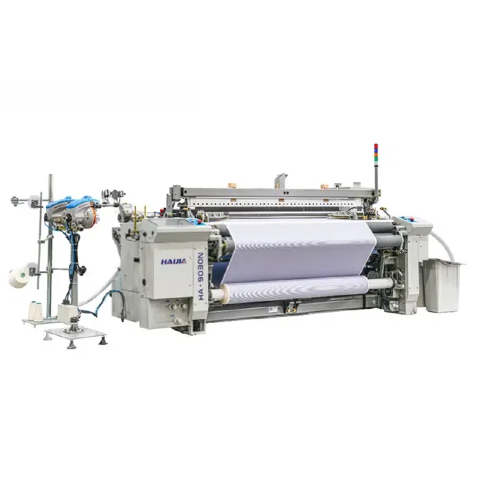
Large-scale textile producers operate in an environment where even marginal efficiency gains can generate substantial financial impact. During a three-month field validation, Haijia’s Air-Jet Looms proved their performance under demanding production conditions.
The 190cm model maintained stable weaving speeds of 900 rpm while processing high-count yarn, with air consumption as low as 0.75 m³/min. Meanwhile, the 280cm wide configuration achieved 600 rpm at just 0.95 m³/min. Overall energy consumption was reduced by more than 20% compared with competing machines.
These results reinforced Haijia’s reputation as a manufacturer capable of delivering not just speed, but intelligent energy optimization—an increasingly critical factor as textile mills prioritize sustainability alongside profitability.
What convinced Weiqiao was not a single specification, but a comprehensive engineering approach. Haijia Machinery designs Air-Jet Looms with a focus on airflow efficiency, structural stability, and precision control systems that support consistent fabric formation.
Reduced vibration helps minimize defects, while optimized yarn insertion improves weaving accuracy across high-speed operations. For industrial buyers, this translates into higher fabric yield, fewer production interruptions, and more predictable operating costs.
Equally important is lifecycle reliability. Durable core components and simplified maintenance structures allow factories to sustain continuous production without excessive downtime—an essential requirement for modern textile enterprises competing on global timelines.
| Factor | Advanced Air-Jet Looms | Traditional Imported Machines |
|---|---|---|
| Energy Consumption | Optimized for lower usage | Often higher in continuous production |
| Production Stability | Designed for consistent high-speed output | Strong but energy intensive |
| Maintenance | Streamlined servicing | Typically more complex |
| Return on Investment | Faster payback potential | Longer recovery cycle |
As procurement strategies evolve, many manufacturers are shifting focus from brand legacy to measurable operational value. Haijia’s success in this partnership reflects that broader industry transition.
Supplying hundreds of machines requires more than technical expertise—it demands production capacity, quality control, and coordinated delivery. Executing a 720-unit deployment highlighted Haijia Machinery’s ability to support large industrial projects with reliable timelines and consistent product standards.
Such scalability reassures global buyers that the company can serve not only as an equipment supplier but as a long-term production partner capable of supporting expansion strategies.
Today, Haijia exports Air-Jet Looms to more than 20 countries across Asia, the Middle East, South America, and Africa, with export growth exceeding 30% year over year. This expanding international footprint further strengthens confidence in the company’s engineering and manufacturing strength.
Continuous investment in research and development remains central to Haijia’s strategy. By advancing shuttleless weaving technology and improving core component independence, the company is positioning itself at the forefront of high-efficiency textile machinery.
The collaboration with Weiqiao illustrates a larger narrative unfolding across the industry: modern Air-Jet Loom manufacturers are no longer defined by geography, but by innovation, performance, and their ability to solve real production challenges.
For textile leaders planning the next phase of modernization, adopting advanced Air-Jet Loom technology is increasingly viewed as a strategic move rather than a simple equipment upgrade.
As textile manufacturing accelerates toward automation, intelligent monitoring, and greener production models, partnerships between forward-looking mills and technology-driven machinery suppliers will shape the industry’s next decade.
Haijia Machinery’s work with Weiqiao Group demonstrates how the right collaboration can unlock higher efficiency, stronger output quality, and long-term operational resilience. More importantly, it signals a shift in global perception—where advanced Air-Jet Loom solutions are recognized not merely as alternatives to imported machines, but as competitive leaders in modern weaving.
Looking to enhance your production efficiency? Discover how advanced Air-Jet Looms can reduce energy consumption while maximizing output. Contact our specialists today to explore solutions tailored to your textile facility.
Air-Jet Looms combine high-speed weaving with optimized air consumption, enabling manufacturers to increase output without proportionally raising energy costs. This balance supports faster returns on capital investment while strengthening long-term competitiveness.
Industrial buyers typically evaluate energy efficiency, machine stability, fabric quality, lifecycle maintenance costs, and supplier scalability. Proven collaboration with major textile producers is often seen as a strong indicator of manufacturing reliability.
Yes. Modern machines are engineered to maintain consistent fabric quality even at high operating speeds. Their precision control systems help reduce defects while supporting continuous, large-scale manufacturing environments.
Lower energy consumption reduces operational risk in markets affected by fluctuating utility costs. Over time, efficient machinery allows manufacturers to expand capacity more confidently while maintaining healthier profit margins.
Absolutely. As production technologies grow more sophisticated, textile companies increasingly value long-term partners who can provide technical support, innovation, and scalable solutions—not just equipment.