Tel: +86-532-83130887 Email: eiffel@qdhaijia.net

| Quantity: | |
|---|---|
HW-6012
Haijia
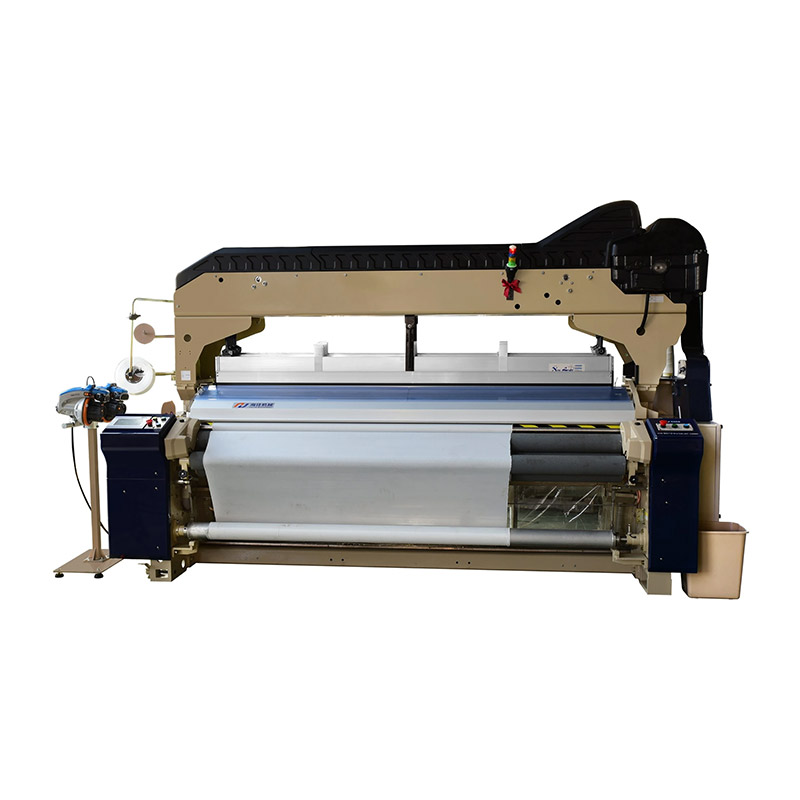
Engineered for continuous, heavy-duty textile manufacturing, the HW-6012 model represents a precise balance of mechanical rigidity and fluid dynamics. Every component is designed to handle the rigorous demands of modern fabric production facilities, ensuring consistent output even under maximum operational loads. By integrating advanced tension control and optimized water flow mechanics, this weaving equipment directly addresses the critical needs of large-scale textile operations, focusing heavily on reducing resource consumption while maintaining strict fabric uniformity across various material types.
The reinforced integrated machine wall board is made by one complete casting which highly improves the frame rigidity and reduces the vibration and noise pollution. Connected with cross beams and middle supporting beam, the re-designed two machine wall boards are firmly jointed together in 20mm lower height which is more suitable for machine operators to manage. To further enhance structural integrity, the entire frame undergoes an industry-leading electrophoretic spraying process, leaving a matte, corrosion-resistant finish that feels cold and solid to the touch. This meticulous surface treatment extends the equipment's operational lifespan to 2-3 times that of standard alternatives, significantly reducing the frequency of maintenance interventions. Even when pushed to maximum capacities of 1200 rpm, the heavy cast-iron foundation absorbs kinetic energy, maintaining a stable, low-vibration environment essential for precise, high-density weaving.
The total tension of the warp is detected by the tension sensor. The CPU handles the change of the warp tension caused by theopening or the change of the loose warp, let off warp and the winding diameter of the warp shaft, and commands the servo motor to drive the warp shaft, so as to maintain the balanced tension during the working process, eliminate the loose and dense gear, and ensure the stability of the fabric tension. This continuous, micro-adjustment capability is particularly crucial when processing sensitive materials like ultra-fine denier yarns or high-density blackout cloths, where even a fraction of tension deviation can result in visible fabric defects. The electronic feedback loop operates with a quiet, rhythmic precision, allowing operators to trust the machine's autonomous corrections during long production shifts without constant manual oversight.
In order to reduce weaving costs and better protect the environment, splash proof "U" nozzles are widely used. Compared with ordinary nozzles, splash proof "U" nozzles have better water line bunching performance. Plunger with smaller diameter is used to achieve stable operation under small opening weft insertion and small water volume.A single loom can save 10% water, which is widely applicable to weaving fine denier, high-density and high-speed fabrics. The controlled spray emits a consistent, sharp hiss as water droplets are precisely shaped to carry the weft yarn across the shed with minimal dispersion. Furthermore, this system is fully compatible with 100% water circulation treatment setups, ensuring that large facilities can meet strict environmental regulations while significantly lowering daily utility expenses.
The optimized beating-up system achieves shorter stroke with low vibration which is designed in modern style on the basis of motion analysis and dynamic equilibrium analysis. The independent developed U type solid beating shaft and beating shaft counter balance system can be used for both narrow machine and wide machine. The small stroke4-inkage beating system is widely acknowledged akconologed for narrow machines while 6-inkage beating system with longer relative static time and stronger beating force provides the best choice for wide machines to make wide and high density fabrics. This modular customization capability ensures that whether a facility is producing standard apparel textiles or specialized wide-format industrial fabrics, the mechanical force is applied with a crisp, decisive snap, locking each weft thread firmly into place without stressing the warp.
Using motorized spindle with no brake disc,which saves more than 20% electricity; by working with the new optimized control system in,the stepless speed change can be achieved. The direct-drive mechanism produces a smooth, consistent hum, eliminating the mechanical friction and wear typically associated with traditional braking components. By significantly reducing power consumption, this intelligent control architecture directly impacts the bottom line of large-scale weaving floors, turning energy efficiency into a measurable operational advantage. The intuitive interface allows technicians to adjust parameters swiftly, maintaining uninterrupted workflows.
It provides larger opening to reduce weft blocking and increase the machine efficiency. With separate selvaging device, it can catch the weft by its own device instead of catching the weft by the movement of two extra heald frames. This independent operation not only simplifies the overall mechanical complexity but also allows for flexible configuration based on specific fabric edge requirements. The precision timing of the selvage catch ensures clean, tightly bound edges, reducing material waste during downstream processing and contributing to a higher yield of premium-grade textile rolls.