Tel: +86-532-83130887 Email: eiffel@qdhaijia.net

Views: 0 Author: Site Editor Publish Time: 2026-04-20 Origin: Site
Is faster weaving the key to staying competitive in modern textile production? Air Jet Loom technology is driving efficiency, stability, and higher output across the industry. In this article, you will learn about market trends, key drivers, challenges, and future opportunities shaping the Air Jet Loom market.
An Air Jet Loom is a high-speed weaving machine that uses compressed air to insert the weft yarn through the warp shed. It replaces traditional mechanical insertion methods, which allows smoother yarn movement and higher production speed. This design reduces friction during operation and improves overall weaving efficiency.
Key working principles and advantages include:
Compressed air-driven weft insertion
The loom uses precisely controlled air nozzles to push the yarn across the warp. This reduces mechanical contact and improves consistency during high-speed operation.
Reduced vibration and improved stability
Fewer moving parts mean less mechanical stress. This helps maintain stable operation even during long production cycles.
Suitable for continuous large-scale production
It supports high output without frequent interruptions. This makes it ideal for modern textile manufacturing environments where efficiency is critical.
Compared with traditional weaving systems, Air Jet Loom technology focuses on balancing speed, quality, and operational stability.
The Air Jet Loom market has shown consistent growth from 2020 to 2025. This growth is closely linked to the increasing demand for automation and higher productivity in textile manufacturing.
Several key patterns can be observed:
Strong demand for production efficiency
Textile manufacturers continue to upgrade equipment to improve output. High-speed weaving machines play a central role in this transition.
Gradual shift toward modernized factories
Many production facilities are moving from manual or semi-automatic systems to more advanced solutions. Air Jet Loom machines fit well into this transformation.
Regional concentration of growth
The majority of demand remains in regions with strong textile industries. These areas continue to invest in advanced weaving technologies.
Growth rates differ depending on the data source, but the overall direction remains stable. This reflects a steady transition toward more efficient and automated textile production systems.
Air Jet Loom machines are widely used across multiple fabric categories. Each application has specific requirements, but all benefit from stable and efficient weaving performance.
Cotton fabrics
Cotton production requires high-speed weaving and consistent yarn handling. Air Jet Loom systems help maintain stable tension and reduce defects during long production runs.
Viscose and blended fabrics
These materials often need more controlled weaving conditions. Air Jet Loom machines provide precise airflow control, which supports smoother yarn insertion and better fabric quality.
Home textiles
Products such as bed sheets, curtains, and upholstery fabrics require both high volume and consistent output. Air Jet Loom technology supports large-scale production with reliable performance.
To better understand how these segments differ:
| Application Type | Key Requirement | Air Jet Loom Advantage |
|---|---|---|
| Cotton | High speed and durability | Stable continuous weaving |
| Viscose | Precision and smooth flow | Controlled airflow insertion |
| Home textiles | Volume and consistency | Reliable large-scale production |
Modern textile manufacturers often prefer machines that can handle multiple fabric types. This flexibility improves production efficiency and reduces the need for frequent equipment changes.
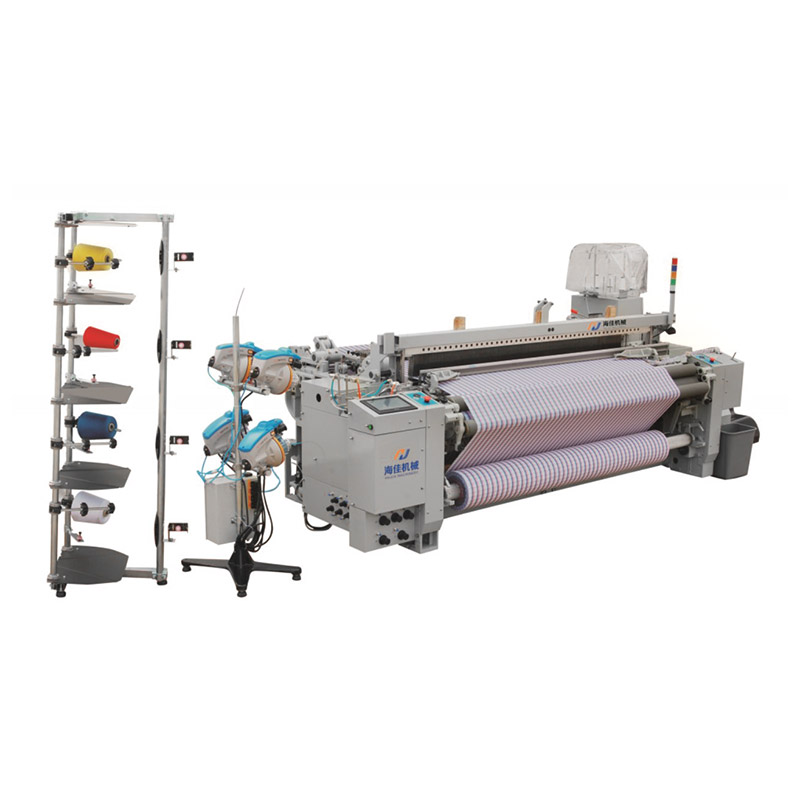
Textile manufacturers continue to face pressure to produce more fabric in less time. Market competition increases every year, so production efficiency becomes a key factor in profitability. Air Jet Loom technology responds to this need by delivering faster weaving speeds while maintaining consistent fabric quality.
Several factors explain why high-speed weaving is becoming essential:
Shorter production cycles for large orders
Faster machines allow factories to complete orders more quickly. This improves delivery timelines and increases customer satisfaction.
Higher output per machine
Increased weaving speed means more fabric produced per day. This reduces the need for additional machines and lowers capital investment per unit of output.
Consistent quality at scale
Maintaining quality during high-speed production is critical. Air Jet Loom systems are designed to keep stable yarn insertion even under demanding conditions.
Energy cost remains one of the most important concerns in textile manufacturing. Air Jet Loom machines rely heavily on compressed air, which directly impacts operating expenses. As a result, energy efficiency has become a major driver of technological improvement.
Manufacturers are focusing on several areas to reduce cost:
Optimizing airflow systems
Improved nozzle design and shorter air paths help reduce air consumption. This directly lowers energy usage without affecting performance.
Reducing power consumption of motors
Modern drive systems improve energy efficiency and reduce unnecessary power loss during operation.
Lower maintenance-related expenses
Efficient machine design reduces wear and tear. This helps decrease downtime and maintenance costs over time.
A simple comparison of cost factors:
| Cost Factor | Traditional Systems | Modern Air Jet Loom Systems |
|---|---|---|
| Air consumption | Higher | Optimized and reduced |
| Power efficiency | Moderate | Improved motor performance |
| Maintenance frequency | Higher | Reduced with better design |
Energy efficiency improvements not only reduce cost but also support more sustainable manufacturing practices.
Automation is changing how textile factories operate. Digital systems are being introduced to improve control, reduce errors, and increase overall efficiency. Air Jet Loom machines are increasingly designed to work within these smart manufacturing environments.
Key developments include:
Real-time monitoring systems
Sensors track machine performance and detect potential issues early. This helps prevent unexpected downtime.
Integration with factory management systems
Data from Air Jet Loom machines can be connected to centralized systems. This improves production planning and resource allocation.
Reduced reliance on manual operation
Automated controls simplify machine operation. This allows fewer operators to manage more equipment efficiently.
These changes help factories improve consistency and reduce operational risks, especially in large-scale production environments.
Emerging markets continue to play a major role in the growth of the Air Jet Loom market. These regions are increasing their textile production capacity and investing in modern equipment to remain competitive.
Several trends support this expansion:
Growth of industrial infrastructure
New textile production facilities are being developed. These facilities often adopt advanced weaving technology from the start.
Cost advantages in manufacturing
Lower labor costs attract investment in textile production. This encourages the adoption of efficient machines to maximize output.
Focus on export-oriented production
Many emerging markets aim to supply global textile demand. This requires consistent quality and high production capacity.
As these regions continue to grow, demand for reliable and efficient Air Jet Loom machines is expected to increase.
Air Jet Loom machines usually require a higher upfront investment compared to many conventional weaving systems. This includes not only the equipment itself, but also supporting systems such as air compressors, pipelines, and installation adjustments. For many manufacturers, especially smaller ones, this creates a noticeable financial burden.
Several cost elements affect the decision:
Equipment and infrastructure setup
The machine cost is only part of the investment. Factories often need to upgrade air supply systems and electrical layouts. These additional costs increase the total budget significantly.
Long return-on-investment cycle
Faster production improves profitability over time. However, the initial expense means it may take longer to recover the investment, especially in markets with tight margins.
Budget limitations in developing regions
Many companies prefer gradual upgrades instead of large investments. They evaluate risk carefully before adopting new Air Jet Loom technology.
| Cost Element | Cost Level | Impact on Investment Decision |
|---|---|---|
| Machine purchase | High | Determines initial capital burden |
| Air system setup | High | Required for operation |
| Installation | Medium | Affects startup timeline |
| Training | Medium | Influences operational efficiency |
Even though manufacturers such as Haijia improve machine efficiency and durability, total cost still plays a key role in purchasing decisions.
Air Jet Loom operation depends heavily on compressed air. Even with improved machine design, air consumption remains a major operating cost. Energy prices also fluctuate, which adds uncertainty to long-term cost planning.
Key pressure points include:
Continuous air usage during weaving
The machine requires stable airflow throughout operation. This creates constant energy demand during production.
System inefficiencies and leakage
Poor pipeline design or aging components can lead to air loss. This reduces efficiency and increases energy cost.
Maintenance of air-related components
Nozzles and valves need regular inspection. Without proper care, performance drops and energy consumption rises.
Manufacturers continue to optimize airflow systems to reduce consumption. Some designs focus on shorter air paths and more precise nozzle control to improve efficiency.
Air Jet Loom systems combine mechanical, pneumatic, and electronic components. Regular maintenance is necessary to keep performance stable. However, this also creates challenges related to workforce skills.
Common issues include:
Need for trained operators
Operators must understand machine settings and airflow control. Without proper training, efficiency decreases and errors increase.
Technical complexity of modern systems
Newer machines include sensors and digital control systems. These require knowledge beyond basic mechanical operation.
Downtime caused by delayed troubleshooting
When faults are not identified quickly, production stops for longer periods. This affects delivery schedules and overall output.
The Air Jet Loom market outlook between 2026 and 2034 shows positive direction overall. However, different reports present different growth rates. This creates uncertainty when planning long-term investments.
Several factors explain this variation:
Differences in research methods
Each report uses its own assumptions and data sources. This leads to different projections for market growth.
Changing global textile demand
Demand for fabrics depends on economic conditions and consumer trends. This directly affects machinery investment cycles.
Technology choices within the weaving industry
Manufacturers may choose different loom types based on cost, fabric type, and production goals.
Instead of relying on one forecast, many buyers compare multiple data sources. They focus on long-term trends such as efficiency, automation, and production flexibility when evaluating Air Jet Loom investments.
Air Jet Loom technology continues to evolve as manufacturers focus on improving performance and efficiency. New designs aim to optimize airflow, enhance structural stability, and support higher weaving speeds without compromising fabric quality.
Several innovation directions are shaping the next generation of machines:
Advanced nozzle systems
New nozzle designs improve air distribution and reduce unnecessary air consumption. This allows more precise weft insertion and better fabric consistency during high-speed operation.
Stronger and more stable machine structures
Reinforced frames and optimized beam designs help reduce vibration. This improves stability and supports long production cycles with fewer interruptions.
Improved control systems
Modern Air Jet Loom machines use more precise electronic controls. These systems help adjust weaving parameters in real time and improve overall production accuracy.
Digital transformation is becoming a core part of textile production. Air Jet Loom machines are increasingly integrated into smart factory environments, where data plays a key role in decision-making.
Key developments include:
Real-time performance monitoring
Sensors collect data on speed, air pressure, and machine status. This allows operators to track performance continuously and respond quickly to changes.
Predictive maintenance systems
Data analysis helps identify potential issues before they become serious problems. This reduces unexpected downtime and improves machine reliability.
Centralized production management
Air Jet Loom machines can connect to factory management systems. This enables better scheduling, resource allocation, and production tracking.
These systems help improve efficiency while reducing manual intervention. They also support more consistent production outcomes across different batches.
Market demand is shifting toward more flexible production capabilities. Textile manufacturers often need to switch between different fabric types based on customer requirements. This increases the importance of versatile Air Jet Loom machines.
Key advantages of multi-fabric capability:
Reduced equipment switching
A single machine can handle multiple fabric types. This minimizes downtime and simplifies production planning.
Improved machine utilization
Flexible machines can operate across different product lines. This increases overall efficiency and reduces idle time.
Better response to market changes
Manufacturers can adapt quickly to new orders or changing demand. This improves competitiveness in dynamic markets.
As demand for customization and shorter production cycles grows, versatile Air Jet Loom solutions are becoming more important. Manufacturers such as Haijia are focusing on fabric adaptability and stable performance to support these changing requirements.
The Air Jet Loom market shows steady growth through 2034. Demand focuses on speed, efficiency, and flexibility. Challenges include cost and energy use, but innovation continues. Haijia provides reliable Air Jet Loom solutions with stable performance, energy-saving design, and strong technical support.
A: Air Jet Loom is used for fast weaving of cotton and home textiles.
A: Air Jet Loom uses air to insert yarn, which increases speed and stability.
A: Air Jet Loom relies on compressed air, which affects operating cost.
A: Air Jet Loom cost depends on size, features, and system setup.
A: Air Jet Loom issues include air leakage and improper maintenance.