Tel: +86-532-83130887 Email: eiffel@qdhaijia.net

Views: 0 Author: Site Editor Publish Time: 2026-07-16 Origin: Site
Textile manufacturers face a persistent operational challenge on the factory floor. They must produce highly intricate, customized fabric patterns without sacrificing the throughput required for commercial viability. Historical Jacquard weaving relied on slow, mechanical punch cards, limiting production speed and flexibility. Today, modern facilities operate digitally integrated systems that execute complex designs at remarkable speeds. Balancing artistic complexity with industrial output demands advanced engineering and precise equipment selection.
The modern production ecosystem solves this bottleneck effectively. Electronic Jacquard shedding mechanisms pair seamlessly with advanced weft insertion systems. Specifically, integrating an air jet loom bridges the gap between intricate design requirements and high-speed industrial output. This combination allows mills to weave elaborate patterns while maintaining the rapid production cycles necessary to stay competitive. Upgrading to this technology requires a deep understanding of shedding mechanics, pneumatic insertion, and facility infrastructure.
Digital-to-Physical Precision: Modern Jacquard weaving relies on CAD-to-loom software, translating digital pixels directly into individual warp thread lifts, eliminating mechanical setup limitations.
Throughput vs. Complexity: Pairing an electronic Jacquard head with an air jet loom maximizes production speed (PPM) for complex patterns, though it requires specific facility infrastructure.
Technology Trade-offs: Selecting the right base loom (air jet vs. rapier) dictates yarn compatibility, energy consumption, and overall operational expenditure (OpEx).
Implementation Realities: Upgrading to high-speed Jacquard production demands rigorous environmental controls, precise yarn tensioning, and specialized maintenance protocols.
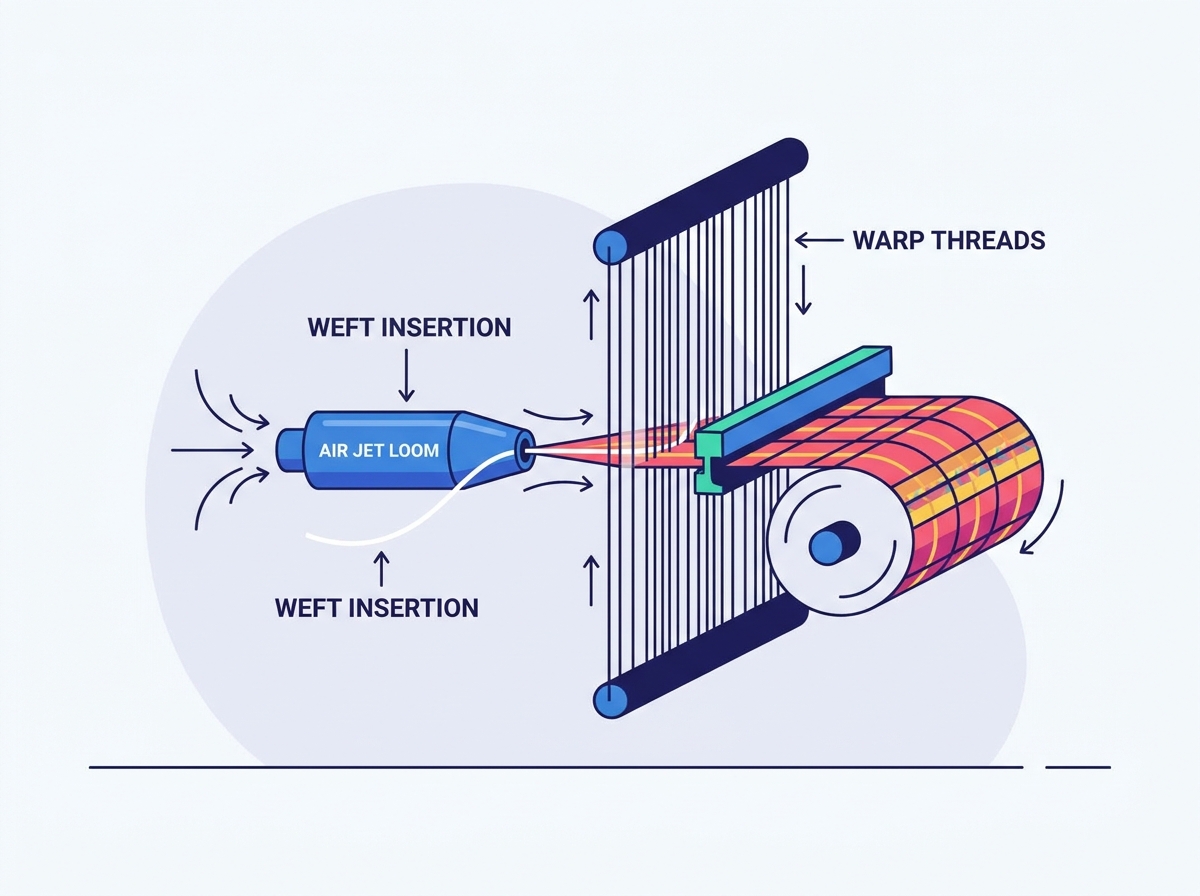
The fundamental differentiator of Jacquard weaving lies in its shedding mechanism. Standard dobby looms lift warp yarns in fixed groups using harness frames. A Jacquard system controls each warp thread independently. This independent lifting and lowering creates the shed through which the weft yarn travels. By manipulating single threads, operators achieve unparalleled design intricacies directly in the fabric structure.
The physical mechanics rely on precise coordination between the shedding head and the insertion system. Weft threads pass over and under these individually controlled warp threads. This interlacing constructs complex patterns, rich textures, and detailed imagery. Because the shedding is independent, the process allows for limitless pattern dimensions. Operators can weave smooth curves, localized fabric structures, and non-repeating motifs without the mechanical constraints of traditional harness frames. Each warp end passes through a heddle attached to a harness cord, which connects to a specific hook in the Jacquard head. When the machine commands a lift, the hook engages with a rising knife grid, pulling the warp thread upward.
This level of control requires robust mechanical support. The harness cords must withstand millions of high-speed cycles without stretching or breaking. Return springs or elastics attached to the bottom of the heddles ensure the warp threads snap back into the lower shed position instantly. This rapid, precise movement is non-negotiable when paired with high-speed pneumatic insertion.
The historical punch-card system revolutionized early textile production. Chains of thousands of laced paper cards physically read patterns. The holes in the cards allowed specific needles to pass, lifting the corresponding warp threads, while solid paper blocked others. This method served as the world's first binary data processing model, laying the groundwork for automated manufacturing.
This physical loom programming directly inspired modern computing. The binary system of ones and zeros descended from these very punch cards. Today, the industry has transitioned entirely to electronic Jacquard heads. Electromagnets and specialized hooks now execute digital commands in milliseconds. When a digital signal indicates a lift, an electromagnet activates, retaining a retaining hook and allowing the lifting hook to catch the moving knife grid.
This modern setup enables rapid style changes. It completely eliminates the downtime once required for mechanical card-punching, lacing, and physical storage. Technicians can switch a loom from weaving a floral damask to a geometric pattern in the time it takes to load a new file over the network. The elimination of moving mechanical reading parts also drastically reduces maintenance requirements and mechanical wear.
Modern fabric production begins on a screen rather than a drafting board. The workflow starts with an initial artistic design, often created as raster or vector graphics. Designers import these concepts into specialized textile CAD software. Here, the visual artwork transforms into a structural blueprint for the weaving equipment.
Operators assign specific weave structures to different color zones or pixels within the digital file. Intricate damasks, heavy brocades, and multi-layered fabrics require distinct interlacing rules. The CAD software pre-calculates every single warp and weft intersection. This pre-calculation is critical to maintain fabric stability and prevent yarn slippage during high-speed insertion. The software ensures that float lengths—the distance a yarn travels without interlacing—do not exceed structural limits.
Design Phase | Software Action | Production Output |
|---|---|---|
Artwork Import | Rasterization and color reduction | Base pixel map for pattern dimensions |
Weave Assignment | Applying twills, satins, and plain weaves to colors | Structural integrity and texture definition |
Float Checking | Automated scanning for excessive loose yarns | Prevention of snagging and fabric defects |
File Export | Compilation into machine-readable formats (.jc5, .epj) | Direct execution commands for the Jacquard head |
Once the design is structurally sound, the software generates finalized production files. Facilities transmit these files over secure factory networks directly to the machine's controller. Physical media transfers, like USB drives or floppy disks, are largely obsolete in modern, efficient mills.
This networked communication offers significant operational advantages. Production managers can initiate seamless pattern switching from a central control room. Reduced setup times mean machines spend more hours actively weaving. Centralized production management ensures that multiple machines can execute coordinated runs with absolute consistency. It also allows for real-time monitoring of pick counts, machine stops, and overall shift efficiency.
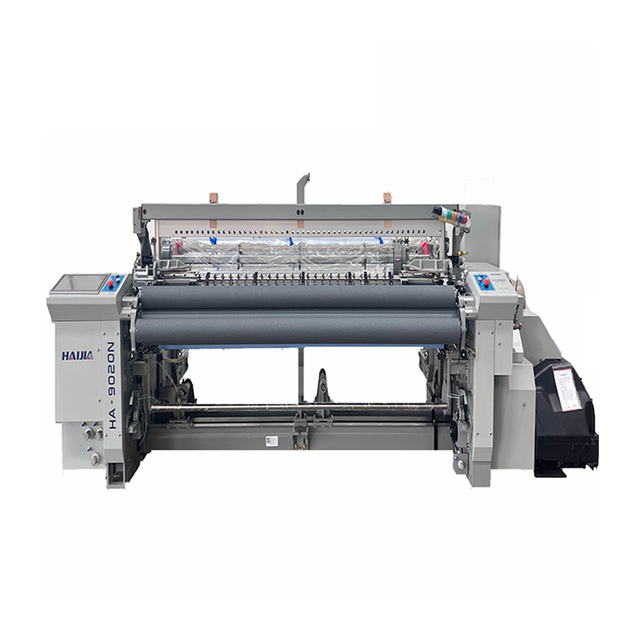
Pneumatic weaving equipment operates using highly controlled compressed air. It utilizes a main nozzle to introduce the weft yarn into the shed. Auxiliary relay nozzles then fire sequentially, propelling the yarn across the width of the machine using precise pulses of air. A specialized profile reed guides the air flow, creating a localized channel that prevents the air from dissipating. This frictionless insertion method allows for extraordinary weaving speeds, often exceeding 800 picks per minute depending on the width.
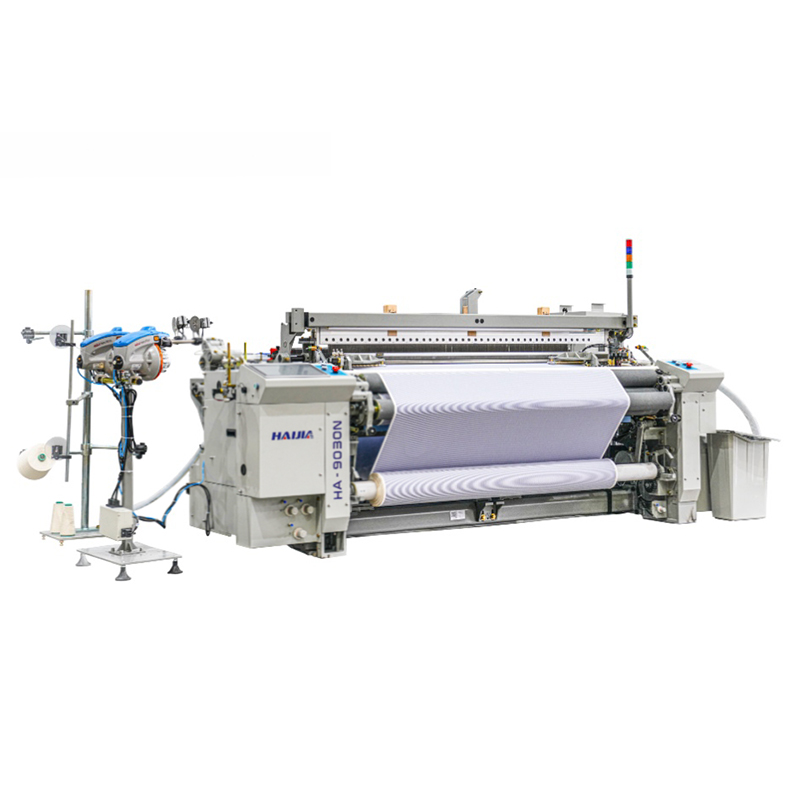
Integrating an electronic Jacquard head requires mounting the unit directly above the machine on a heavy-duty gantry. This setup demands precise synchronization. The high-speed shedding motion of the Jacquard hooks must align perfectly with the pneumatic weft insertion. Even a millisecond delay can cause the air pulse to misdirect the yarn, resulting in severe fabric defects. The shed must be fully open and clear before the main nozzle fires, and it must close at the exact moment the weft arrives at the opposite selvedge.
Choosing the correct base technology dictates your production capabilities. The high picks-per-minute (PPM) of pneumatic insertion sharply contrasts against the slower, mechanical insertion of a rapier machine. However, speed is only one factor in the decision matrix. Plant managers must evaluate their specific product mix before committing to a technology.
Yarn and fabric compatibility often dictate the final choice. Pneumatic systems require uniform, high-tensile yarns that can withstand the sudden force of compressed air. They excel at high-volume, uniform Jacquard fabrics like lining materials, mattress ticking, and light home textiles. Conversely, rapier machines remain necessary for delicate, highly textured, or multi-colored novelty yarns used in heavy tapestries and complex brocades. Energy consumption also varies; pneumatic systems draw heavily on compressed air, while rapier systems rely on mechanical motor power.
Operational Metric | Pneumatic Insertion (Air Jet) | Mechanical Insertion (Rapier) |
|---|---|---|
Production Speed (PPM) | 800 - 1200+ (Width dependent) | 400 - 700 |
Yarn Requirements | High tensile strength, uniform, smooth | Handles weak, textured, and heavy yarns |
Color Capabilities | Typically up to 6-8 weft colors | Up to 12+ weft colors |
Primary Energy Source | High-capacity compressed air | Direct electrical motor drive |
Ideal Applications | Mattress ticking, apparel linings, airbags | Upholstery, heavy brocades, technical textiles |
Combining high-speed air insertion with complex Jacquard shedding makes warp tensioning a critical operational focus. The independent lifting of thousands of threads creates varying tension profiles across the fabric width. Improper tension leads to poor shed clearance. If warp threads sag, they disrupt the air flow carrying the weft yarn, causing the yarn to buckle or loop.
Automated electronic let-off (ELO) and electronic take-up (ETU) mechanisms are mandatory. These systems continuously monitor and adjust the tension of the warp beam and the woven fabric roll. Load cells detect minute changes in warp tension and signal the let-off motor to adjust its feed rate. Maintaining optimal shed geometry prevents yarn breakage, minimizes friction against the reed, and ensures that the pneumatic insertion operates without obstruction.
Operating high-speed pneumatic weaving equipment with top-mounted electronic heads requires robust facility infrastructure. Mills must install industrial-grade, oil-free air compressors, typically rotary screw models. Oil contamination in the air lines will ruin the fabric and degrade the internal valves of the nozzles. Stabilized power supplies are non-negotiable to protect sensitive electronic boards from voltage spikes. Furthermore, the facility requires reinforced flooring to handle the extreme high-frequency vibration generated by the rapid shedding and insertion cycles.
Strict climate control is equally essential on the weaving floor. Facilities must regulate humidity and temperature meticulously. Proper moisture levels (typically 65-70% Relative Humidity) maintain yarn elasticity and prevent static buildup. Static electricity is particularly detrimental during high-speed pneumatic insertion. It causes yarns to cling together, blocking the shed and causing the weft yarn to crash during flight.
Install Class 0 oil-free rotary screw air compressors with adequate CFM capacity.
Implement desiccant air dryers to remove moisture from the pneumatic lines.
Reinforce concrete flooring and install vibration isolation pads under the loom feet.
Deploy overhead HVAC systems capable of maintaining strict temperature and humidity tolerances.
Install uninterruptible power supplies (UPS) for the Jacquard controllers to prevent data loss during power dips.
While digital file transfers are instantaneous, physical setup still requires time. Tying-in new warp beams is a labor-intensive process. Technicians use automated knotting machines to tie thousands of new warp ends to the existing ends in the harness. The extensive Jacquard harness cords also require regular inspection and maintenance to prevent mislifts. Dust and lint accumulation can quickly degrade harness performance, causing the cords to stick.
Facilities must implement strategies for minimizing downtime during pattern changeovers. Leveraging electronic control systems allows operators to pre-program sequential designs on the same warp beam. Proper scheduling and preventative maintenance of the harness cords ensure that physical changeovers do not negate the speed advantages of the equipment. Quick Style Change (QSC) systems allow technicians to swap entire warp beams and harness frames as a single module, drastically reducing machine downtime.
High-speed production amplifies the risk of rapid defect generation. Common defects in this specialized weaving include mispicks, dropped ends, and air-flow irregularities that cause looped wefts. Because the patterns are intricate, visual detection by human operators is often too slow. A machine running at 800 PPM will weave yards of defective fabric before an operator notices a missing thread.
Automated optical inspection systems are necessary to maintain commercial yield rates. These camera-based systems scan the fabric in real-time, instantly identifying deviations from the digital pattern file. Highly sensitive laser stop-motions immediately halt the machine if a warp or weft thread breaks. Drop wires on the warp ends drop upon loss of tension, completing an electrical circuit that triggers an instant machine stop.
Upgrading to advanced weaving technology requires a significant initial investment. Purchasing a pneumatic insertion machine equipped with a high-capacity electronic Jacquard head involves substantial capital expenditure. Facility upgrades for air compressors, piping, and climate control add heavily to this initial outlay.
However, operators must compare this against long-term operational efficiency. High-speed equipment drastically increases production volume per shift. It reduces the labor required per yard of fabric. One operator can oversee multiple high-speed machines compared to older, slower equipment. When paired with automated inspection, these machines significantly lower defect rates and material waste. These OpEx savings often justify the initial infrastructure costs over the equipment's lifespan.
Buyers should calculate ROI based on their specific product mix. A facility producing high-volume, standardized upholstery or mattress ticking will realize a faster return than a mill focused on bespoke, short-run apparel fabrics. The continuous demand for output maximizes the efficiency of pneumatic insertion.
When evaluating profitability, operators must factor in the cost of continuous compressed air generation. Air compressors consume significant electricity, often accounting for a large portion of the plant's energy bill. Optimizing nozzle pressure, utilizing energy-saving relay valves, and eliminating air leaks in the facility network are critical steps to ensuring the technology upgrade remains financially viable. Yield improvements from reduced defects also play a major role in shortening the payback period.
Modern Jacquard weaving combines digital design, intelligent control systems, and high-speed air jet technology to achieve exceptional fabric quality and production efficiency. By optimizing CAD workflows, warp tension control, pneumatic weft insertion, and factory infrastructure, textile manufacturers can increase output, reduce defects, and efficiently produce complex woven fabrics for a wide range of commercial applications.
Working with an experienced textile machinery manufacturer is equally important for ensuring reliable production performance and sustainable business growth. Haijia specializes in advanced air jet looms, water jet looms, and intelligent weaving solutions. With innovative engineering, strict quality control, and comprehensive technical support, we help textile manufacturers improve weaving efficiency, optimize fabric quality, and expand production capacity across home textiles, apparel fabrics, technical textiles, and industrial applications.
Audit your facility's current compressed air capacity and quality to ensure it meets oil-free, industrial-grade standards.
Evaluate your existing CAD software to confirm compatibility with modern electronic Jacquard controllers and network protocols.
Request performance simulations from loom manufacturers based on your specific yarn types and pattern complexities.
Implement rigorous climate control protocols to maintain optimal humidity and temperature in your weaving shed.
Establish a preventative maintenance schedule specifically for harness cords and pneumatic nozzles to prevent unexpected downtime.
A: Yes. By mounting an electronic Jacquard head above the machine, the individual warp thread control synchronizes with the air jet weft insertion system. This allows for the high-speed production of complex, intricate fabric patterns.
A: Dobby weaving uses harnesses to lift warp threads in fixed groups, limiting pattern complexity. Jacquard weaving controls each warp thread individually, allowing for limitless, non-repeating designs, curves, and highly detailed imagery.
A: The original loom used a sequence of laced punch cards to dictate patterns. The presence or absence of a hole acted as binary data. This physical programming directly inspired the binary logic used in early computers.
A: Industrial operating speeds vary based on fabric width and pattern complexity, but they typically range between 600 to over 1000 picks per minute (PPM). Wider fabrics or extremely dense patterns require slightly reduced speeds.
A: This setup excels at producing high-volume, uniform-density fabrics. Ideal applications include mattress ticking, lining fabrics, damasks, and specific technical textiles that utilize strong, uniform yarns capable of withstanding air jet force.
A: Highly textured, weak, uneven, or excessively heavy novelty yarns perform poorly. The sudden force of compressed air can break weak yarns or fail to propel heavy, textured yarns accurately across the shed.