Tel: +86-532-83130887 Email: eiffel@qdhaijia.net

Views: 0 Author: Site Editor Publish Time: 2026-07-16 Origin: Site
High-speed textile manufacturing demands a precise balance between production efficiency and the mechanical requirements of the final fabric. Pushing looms to their maximum speed cannot come at the expense of material integrity. When mills select an inappropriate weave structure for a specific end-use, the results are predictable. You see mechanical failures like poor tear strength, dimensional instability causing shrinkage or skewing, or aesthetic rejection. These issues lead to costly production waste and compromised product lifecycles.
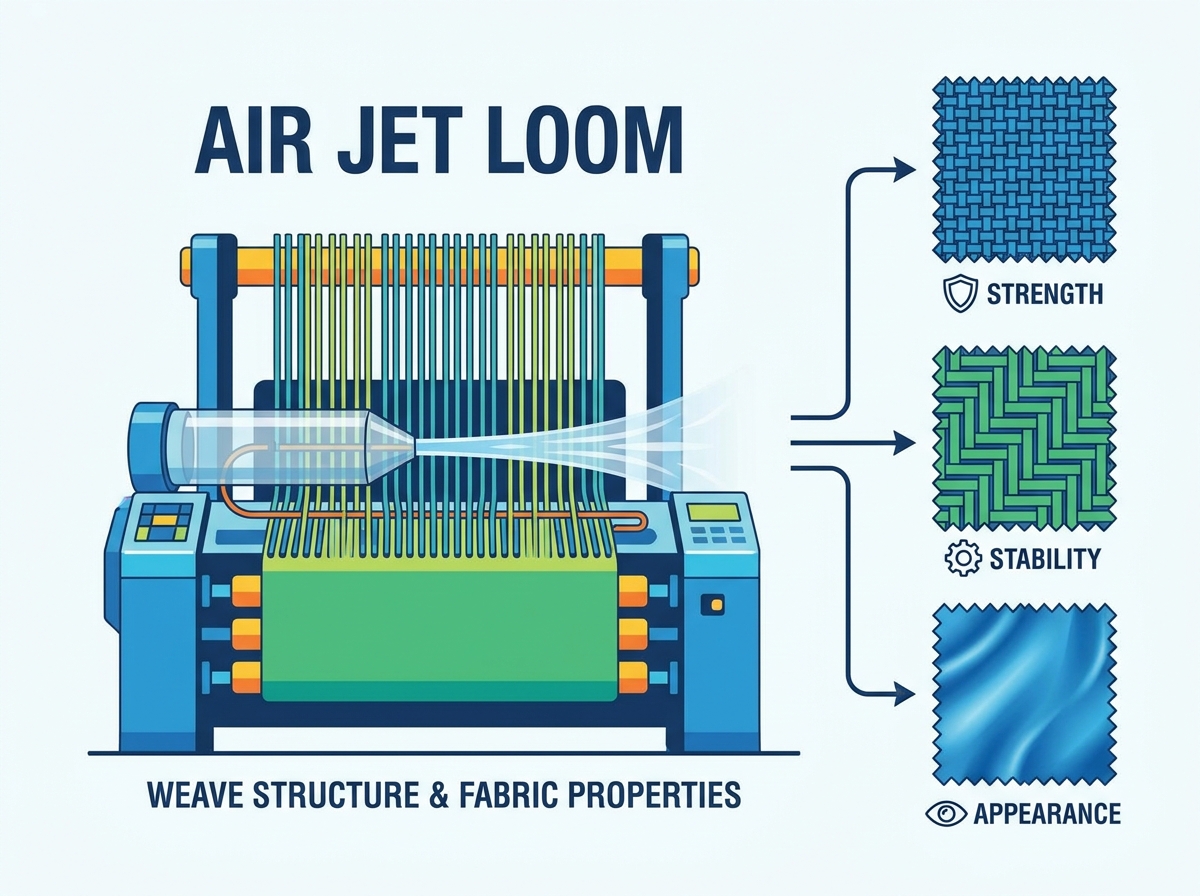
To prevent these failures, textile engineers must align weave architecture with the high-speed weft insertion capabilities of modern machinery. Whether producing plain, twill, or satin structures, understanding how interlacing patterns interact with an air jet loom is essential. This alignment allows manufacturers to predictably engineer fabric strength, stability, and surface appearance for commercial and industrial applications.
Interlacing Frequency Dictates Strength Profiles: High interlacing (plain weave) maximizes tensile strength and dimensional stability, while lower interlacing (twill weave) increases tear resistance and flexibility.
Air Jet Loom Compatibility: Production efficiency on an air jet loom relies heavily on the chosen weave structure; complex weaves or highly dense warp setups require precise tension control and specialized shedding mechanisms.
The Stability vs. Drape Trade-Off: Fabric structures engineered for maximum dimensional stability inherently sacrifice drape, softness, and aesthetic luster.
Application-Driven Selection: Final weave specification must be reverse-engineered from the product's end-use (e.g., industrial filtration requiring stability vs. apparel requiring abrasion resistance and drape).
Table of Contents
Evaluating fabric viability requires measuring specific mechanical properties on the production floor. Tensile strength determines resistance to pulling forces. Tearing strength measures resistance to propagating a cut or puncture. Dimensional stability evaluates shape retention after washing or mechanical stress. Abrasion resistance indicates how well the surface withstands friction. These primary metrics dictate whether a fabric can survive its intended application in the field.
Advanced comfort and physical performance metrics provide deeper insights into fabric behavior. Bending rigidity measures stiffness and resistance to bending, directly affecting how the material drapes. Water absorption and air permeability determine utility in apparel and technical textiles. The geometry of warp and weft yarn intersections serves as the foundational variable for all these mechanical properties. How yarns cross and bind together dictates how the fabric will perform under physical stress.
Engineers rely on standardized testing to quantify these metrics. Grab tests and strip tests measure tensile strength. Elmendorf tear testing evaluates tear resistance. Martindale or Taber abrasion testers simulate wear. By establishing baseline requirements for these metrics, production teams can reverse-engineer the necessary weave structure before setting up the loom.
Pneumatic weft insertion impacts yarn tension, crimp interchange, and overall fabric tightness differently than traditional shuttle or rapier looms. The rapid burst of air from the main and relay nozzles propels the weft yarn across the shed. This requires precise tension control to maintain uniform structure. This high-speed insertion influences how tightly the warp and weft interlock, directly affecting the structural integrity of the final product.
Fabric tightness, often referred to as the cover factor, interacts with high-speed beat-up to influence warp-weft binding and surface texture. A dense warp setup requires significant force from the reed during beat-up to pack the weft yarns tightly into the fell of the cloth. Uniform beat-up and consistent warp tensioning are vital for achieving consistent fabric architecture at high production speeds. Any variation in tension or beat-up force results in uneven density, compromising both strength and appearance.
Loom technicians must calibrate the shedding timing and air pressure profiles to match the specific yarn characteristics and weave design. If the shed closes too early, it traps the weft yarn, causing a loom stop. If the air pressure is too high, it can damage delicate yarns or blow them out of the profile reed. Mastering these mechanical adjustments ensures the fabric meets the defined success criteria without sacrificing production speed.
Plain weave features a 1/1 interlacing structure, creating the highest possible frequency of yarn crossovers. Every warp yarn alternates over and under every weft yarn. This tight, grid-like architecture locks yarns firmly in place, restricting movement and creating a highly stable fabric structure. Setting up a plain weave requires high warp tension to ensure clean shedding for the frequent interlacements.
The performance outcomes of this frequent interlacing include superior tensile strength, high dimensional stability, and a firm texture. The locked yarns resist pulling forces effectively. However, plain weaves have distinct limitations. The restricted yarn mobility results in lower tear resistance, reduced flexibility, higher bending rigidity, and a higher susceptibility to wrinkling. When a puncture occurs, the rigid structure prevents yarns from grouping together to resist the tear.
Industrial applications heavily favor plain weaves for their stability. Filtration fabrics, canvas, and base fabrics for coating rely on the predictable pore size and structural rigidity provided by the 1/1 interlacing. When weaving these dense structures pneumatically, technicians must monitor the beat-up line closely to prevent reed marks and ensure uniform pick density.
Twill weaves create a distinct diagonal rib, or wale, across the fabric surface. This pattern results from staggered interlacements, such as 2/1 or 3/1 structures, where a warp yarn floats over multiple weft yarns before interlacing. This staggering reduces the total number of intersections compared to a plain weave. The angle of the wale depends on the ratio of warp to weft density and the specific interlacing pattern.
This mechanical shift significantly alters fabric performance. Fewer interlacements allow yarns to shift and group together when subjected to tearing forces, significantly improving tearing strength. The longer floats also enhance abrasion resistance while offering better drape and lower bending rigidity than plain weaves. The fabric feels softer and conforms more easily to shapes, making it ideal for durable apparel like denim and workwear.
Running twill weaves requires different loom settings than plain weaves. The shedding cams or dobbies must be programmed for the specific staggered pattern. Because there are fewer interlacements, the warp tension can often be slightly lower, reducing the strain on the yarns. However, technicians must ensure the air insertion timing accommodates the longer floats to prevent the weft from catching on adjacent warp ends.
Satin and sateen structures are defined by long floats, where yarns pass over four or more perpendicular yarns before interlacing. This creates a surface dominated by uninterrupted yarns, minimizing the visible intersections that disrupt light reflection. A 5-end or 8-end satin is common, requiring a dobby or jacquard shedding mechanism due to the complex interlacing sequence.
The primary outcomes of satin weaves are maximum surface smoothness, high luster, and excellent drape. The lack of frequent interlacing allows the fabric to flow and bend easily. However, these long floats create critical vulnerabilities. Satin weaves suffer from poor dimensional stability, low abrasion resistance due to snagging risks, and lower tensile strength. They are generally unsuitable for heavy-duty applications where durability is paramount.
Producing satin efficiently requires careful tension management. The long yarn floats increase the risk of catching or snagging during high-speed pneumatic weft insertion. Precise shedding and air pressure control are necessary to minimize loom stops. Technicians often use specialized profile reeds and optimize relay nozzle angles to ensure the weft yarn travels cleanly across the wide shed without disturbing the floating warp yarns.
Basket weaves are variations of the plain weave, utilizing grouped yarns (e.g., 2/2 or 3/3) that interlace together as a single unit. This grouped structure maintains a grid pattern but reduces the overall number of intersections compared to a standard 1/1 plain weave. The yarns are drawn through the heddles and reed in pairs or larger groups.
This structure improves tear resistance and flexibility over standard plain weaves by allowing slight yarn mobility within the groups. Specific weave patterns, including basket or specialized multi-layer weaves, heavily influence air permeability, thermal insulation, and heat resistance. In industrial safety textiles, these structures can be engineered to trap air or resist thermal degradation more effectively than tightly packed simple weaves.
When weaving basket structures, technicians must monitor yarn rolling. Because multiple yarns travel together, they can twist around each other during insertion or beat-up, creating visual defects. Proper sizing and precise warp tensioning are required to keep the grouped yarns parallel and flat in the final fabric.
An inverse relationship exists between tensile and tearing strength based on weave tightness. Tightly woven plain fabrics possess high tensile strength because the frequent interlacing distributes pulling forces evenly across many locked yarns. However, this rigidity becomes a liability under tearing stress. If a worker snags their plain-weave uniform on a nail, the fabric will likely tear in a straight line.
Plain weaves tear easily once punctured because the locked yarns break individually. Conversely, looser twill structures allow yarns to shift and bunch together at the point of a tear. This grouping effect allows multiple yarns to collectively resist tear propagation, resulting in higher tearing strength despite having lower overall tensile strength than a comparable plain weave. This is why heavy-duty workwear and denim utilize twill structures.
To illustrate these differences, consider the following comparison of core weave structures and their typical performance characteristics when woven with identical yarn counts and densities:
Weave Structure | Interlacing Frequency | Tensile Strength | Tear Resistance | Dimensional Stability | Abrasion Resistance |
|---|---|---|---|---|---|
Plain (1/1) | Maximum | Very High | Low | Excellent | Moderate |
Twill (2/1 or 3/1) | Moderate | High | High | Good | High |
Satin (5-end+) | Low | Moderate | Moderate | Poor | Low (Snagging Risk) |
Basket (2/2) | Moderate (Grouped) | High | Moderate-High | Good | Moderate |
Weave density and interlacing frequency lock yarns in place, preventing skewing and shrinkage. High-density plain weaves offer maximum dimensional stability, retaining their shape under stress and washing. As interlacing decreases in twill and satin weaves, the potential for yarn shifting and dimensional distortion increases. Manufacturers must account for this by adjusting finishing processes, such as heat setting or compressive shrinkage (Sanforizing), to stabilize looser weaves.
Weave structure also dictates pore size, directly impacting air permeability, breathability, and liquid absorption. Tightly woven fabrics restrict airflow and limit water penetration, which is crucial for certain industrial filtration applications or sailcloth. Looser weaves or specific yarn blends increase pore size, enhancing breathability and moisture management for apparel comfort.
Testing these properties requires specific procedures on the production floor:
Cut standardized fabric swatches across the full width of the woven roll to account for edge-to-center variations.
Condition the samples in a controlled environment (standard temperature and humidity) for 24 hours before testing.
Perform air permeability testing using a Frazier or Shirley permeability tester to measure airflow resistance.
Conduct dimensional stability tests by measuring marked benchmarks before and after standardized washing and drying cycles.
The length of yarn floats determines light reflection and tactile smoothness. Long floats in satin weaves create a smooth, highly reflective surface, resulting in a glossy appearance. Short interlacements in plain weaves scatter light, creating a matte finish and a slightly rougher texture. The visual impact is heavily influenced by the yarn type; using continuous filament synthetic yarns in a satin weave maximizes the luster.
Bending rigidity is directly tied to weave structure. Frequent interlacing restricts yarn movement, increasing stiffness and reducing drape. Fabrics with longer floats bend more easily, providing superior drape and flexibility. Manufacturers must balance the desire for aesthetic drape with the need for structural stability. A fabric that drapes beautifully but skews during garment construction will cause massive issues in the cutting room.
Yarn type interacts significantly with the air jet nozzle during weft insertion. Spun yarns, filament yarns, natural fibers, and synthetic blends behave differently under pneumatic propulsion. The surface characteristics and weight of the yarn dictate the required air pressure and nozzle timing for successful insertion across various weave structures. A hairy spun cotton yarn requires different relay nozzle settings than a smooth polyester filament.
Blending fibers, such as cotton-bamboo, affects the physical properties of the fabric, including moisture absorption and bending rigidity. When processed on high-speed looms, these blends require precise tension management. Matching yarn strength and smoothness to the specific demands of the chosen weave is necessary to prevent weft stops and ensure continuous production. Weak yarns will break under the high tension required for dense plain weaves.
Technicians must evaluate the yarn's coefficient of friction. High friction yarns can drag in the profile reed, causing short picks. Applying appropriate sizing compounds to the warp yarns reduces friction and protects them from the abrasive action of the reed and the adjacent yarns during shedding and beat-up.
Weaving high-density plain weaves presents implementation risks, primarily high warp tension and the associated risk of yarn breakage. The frequent shedding requires robust warp preparation. Conversely, satin weaves present challenges with managing loose floats and catching risks during high-speed insertion. If a floating warp yarn sags into the shed, the weft yarn will catch it, causing a major defect and a loom stop.
To mitigate these issues and minimize loom stops, technicians should follow a systematic troubleshooting approach:
Verify the warp tension settings on the let-off motion, ensuring it matches the density requirements of the specific weave structure.
Inspect the shedding cams or dobby programming to confirm the shed opens fully and cleanly without slack yarns.
Calibrate the main nozzle air pressure to provide sufficient initial propulsion without damaging the weft yarn.
Adjust the relay nozzle timing and pressure to carry the weft yarn smoothly across the entire width of the profile reed.
Check the condition of the profile reed for any damaged or bent dents that could obstruct the airflow or snag the yarn.
Evaluate the sizing application on the warp yarns; insufficient sizing leads to excessive shedding and yarn breakage during beat-up.
Pneumatic looms offer exceptional production speed capabilities, but efficiency varies across different weave complexities. Simple plain and twill weaves can run at maximum speeds with minimal interruption, maximizing throughput. Complex weaves or those requiring extremely high pick densities may require speed reductions to maintain quality and prevent excessive yarn breakage.
Loom downtime caused by structural incompatibility or frequent yarn breakages severely impacts production output. The profitability of uninterrupted, high-speed production of simpler weaves often outweighs the margins on complex structures if defect rates are high. Manufacturers must evaluate the true production yield of producing intricate weaves on high-speed machinery. Optimizing the weave structure slightly to improve loom efficiency can drastically increase overall output without compromising the final product's utility.
Matching weave to end-use requires a structured approach based on required performance metrics. For industrial and technical applications, plain weave is often the default for dimensional stability, while basket weaves are utilized for specific heat resistance and filtration requirements. The predictable geometry of plain weaves makes them ideal for coating substrates.
Workwear and denim rely heavily on twill weaves for their superior abrasion resistance, tear strength, and flexibility. The diagonal structure hides soil well and provides the necessary durability for harsh environments. Luxury apparel and bedding prioritize satin weaves for their exceptional drape, smoothness, and surface luster, accepting the trade-offs in durability and stability.
Balancing desired fabric properties with production realities is critical. High tensile strength or specific bending rigidity must be weighed against production defect rates and machine efficiency. A fabric design that looks excellent on paper but causes frequent loom stops will destroy production schedules and increase waste.
Engineers must evaluate material behavior and machine performance to ensure the chosen weave structure can be produced efficiently at scale. Selecting a slightly modified weave that maintains acceptable performance while drastically improving loom efficiency is often the most practical decision. Conducting trial runs and analyzing the defect logs helps pinpoint structural incompatibilities before committing to full-scale production.
Selecting the right weave structure is essential for balancing fabric strength, dimensional stability, appearance, production efficiency, and overall product performance. By matching weave architecture with yarn characteristics, end-use requirements, and high-speed weaving technology, textile manufacturers can consistently produce high-quality fabrics while improving productivity and reducing manufacturing costs.
Working with an experienced weaving machinery manufacturer is equally important for achieving reliable production performance and long-term business success. Haijia specializes in advanced air jet looms, water jet looms, and intelligent weaving solutions. Supported by innovative technology, strict quality management, and comprehensive technical services, we help textile manufacturers improve weaving efficiency, optimize fabric quality, and expand production capabilities across a wide range of textile applications.
Conduct mechanical testing, including tensile, tear, bending rigidity, and air permeability tests, on prototype yardage to verify performance baselines.
Consult with loom technicians to verify compatibility and optimize machine settings, specifically air pressure and shedding timing, before scaling.
Finalize yarn specifications, ensuring the tensile strength and friction coefficients meet the demands of both the weave structure and the high-speed insertion process.
Run a limited pilot production batch to monitor loom stop frequencies and identify any necessary adjustments to the warp tension or beat-up force.FAQ
A: Weave structure affects tensile strength through interlacing frequency. Plain weaves, with the highest number of interlacements, lock yarns tightly together. This frequent binding distributes pulling forces evenly across many locked yarns, resulting in high tensile strength compared to looser weaves where yarns can slip.
A: Twill weaves have fewer interlacements than plain weaves. This allows the yarns to shift and bunch together when subjected to a tearing force. Multiple grouped yarns collectively resist the tear, providing higher tearing strength than the rigid structure of a plain weave where yarns break individually.
A: These looms utilize high-speed pneumatic weft insertion and strong beat-up mechanisms. This allows them to efficiently pack weft yarns tightly into the warp shed, achieving the high cover factor required for dense plain weaves while maintaining high production speeds and uniform tension.
A: Frequent interlacing, as seen in plain weaves, restricts yarn movement and locks the fabric structure in place. This high density prevents yarns from shifting, skewing, or shrinking significantly during washing or under mechanical stress, ensuring excellent dimensional stability compared to looser satin structures.
A: Yes, but it requires careful tension management. The long yarn floats characteristic of satin weaves increase the risk of catching or snagging during high-speed pneumatic weft insertion. Precise shedding and air pressure control are necessary to minimize loom stops and prevent defects.
A: Long yarn floats create a smooth surface that reflects light evenly, resulting in high surface luster. However, these exposed floats are more susceptible to snagging and friction, which significantly reduces the fabric's overall abrasion resistance compared to tightly woven structures with frequent interlacements.