Tel: +86-532-83130887 Email: eiffel@qdhaijia.net

Views: 0 Author: Site Editor Publish Time: 2026-07-16 Origin: Site
The industrial demand for high-strength, dimensionally stable open-weave fabrics requires manufacturing methods that balance structural integrity with production speed. Medical gauze, heavy-duty geotextiles, and agricultural nets rely on these specific weave structures to function. Traditional leno weaving relies on complex doup attachments and specialized harnesses. These legacy setups subject yarns to high strain, resulting in frequent breakages, high maintenance demands, and severely limited production speeds. Manual methods using pick-up sticks and early mechanized hand loom modifications simply cannot meet modern industrial volume requirements.
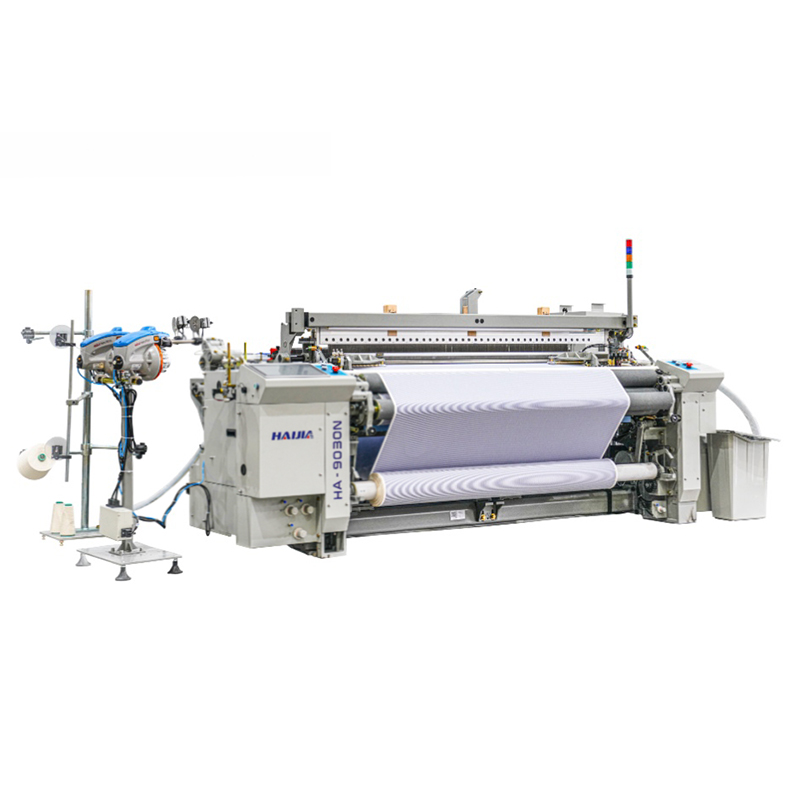
To meet commercial volume targets without sacrificing the slip-resistant properties of the leno structure, textile manufacturers must transition from low-speed dobby setups to modern high-speed weaving technologies. This guide breaks down the leno weaving process, contrasts artisanal techniques with industrial mechanics, and provides a technical evaluation of utilizing an air jet loom to scale open-weave fabric production effectively.
Structural Superiority: The leno weave (or plain gauze weave) locks weft yarns in place by crossing two non-parallel warp yarns (the ground/standard warp and the doup/crossing warp), creating the strongest possible lightweight, low-density fabric structure that resists yarn slippage.
Production Bottlenecks: Conventional dobby shedding mechanisms and manual pick-up techniques for leno weaves are historically time-consuming and costly due to mechanical friction, complex harness setups, and high yarn tension.
The Air Jet Loom Advantage: Integrating rotary leno devices or specialized planetary leno motions onto an air jet loom significantly increases picks per minute (PPM), eliminating legacy speed barriers in technical textile manufacturing.
Implementation Trade-offs: Upgrading to an air jet loom requires evaluating the high initial capital expenditure (CAPEX) and pneumatic energy costs against the long-term gains in production efficiency and fabric yield.
Table of Contents
Defining the structural requirements of open-weave fabrics reveals exactly why traditional parallel-yarn plain weaves fail in specific applications. When weaving low-density configurations, standard plain weaves suffer from severe yarn slippage. The yarns shift out of place under minimal friction, leading to warping, uneven gaps, and a complete lack of durability. The leno weave solves these mechanical failures through a specialized interlocking mechanism that secures every single intersection.
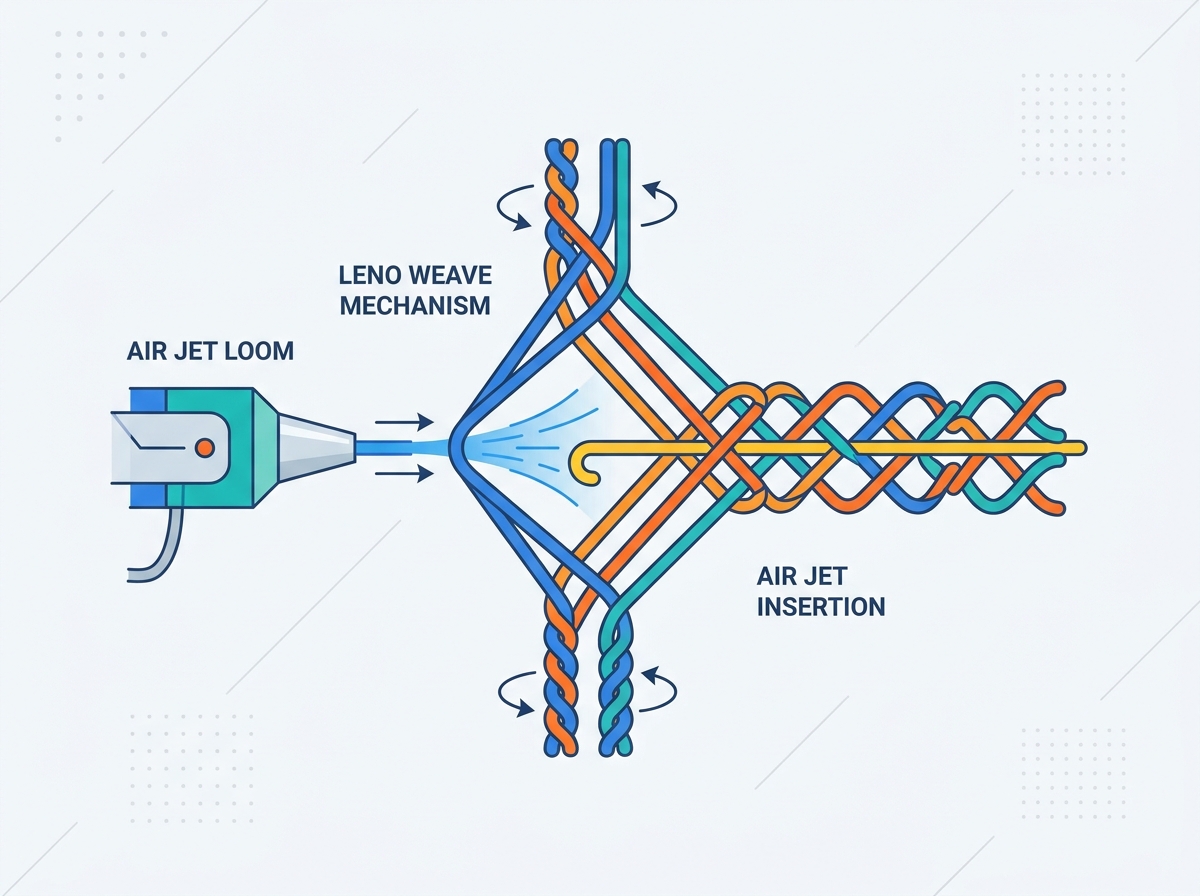
The core strength of the leno weave lies in its non-parallel warp alignment. In a standard setup, warp yarns run perfectly parallel to each other. In a leno configuration, the standard ground warp yarn and the crossing doup warp yarn deviate from these parallel paths. They physically twist around each other between every weft insertion. This crossing mechanism binds the weft filling yarn firmly in place at each pick. It acts like a knot, preventing any lateral movement of the weft yarn across the fabric width.
To understand the mechanics on the factory floor, consider the shedding cycle. The harness lifts the doup thread, pulls it across the ground thread, and holds it while the weft is inserted. Once the reed beats up the weft, the doup thread crosses back. This continuous figure-eight motion locks the grid in place. It requires precise tension control to prevent the crossing yarns from snapping under the friction of the twist.
The plain gauze weave structure provides the highest tensile strength-to-weight ratio of any open-mesh textile available today. When evaluating fabric performance, engineers look at specific metrics. Mesh stability ensures the hole size remains constant. Shear resistance prevents the fabric from distorting diagonally. Breathability allows air or fluid passage, which is vital for medical and agricultural uses. Dimensional integrity under tension means the fabric will not stretch out of shape when pulled.
Performance Metric | Plain Weave (Low Density) | Leno Weave (Low Density) |
|---|---|---|
Yarn Slippage | High - yarns shift easily | Zero - yarns are locked in place |
Shear Resistance | Poor - distorts diagonally | Excellent - maintains grid shape |
Tensile Strength | Low - relies on yarn friction | High - relies on mechanical lock |
Production Speed | Very High | Moderate to High (Equipment dependent) |
The artisanal baseline for open-weave fabrics involves hand-manipulated techniques. Methods such as Leno Lace and Brooks Bouquet rely entirely on the weaver's skill. In hand-weaving, the operator uses a manual pick-up stick to physically lift and twist warp ends before locking them with a weft pick. While this produces beautiful, intricate textiles, the output is measured in inches per hour. This method is entirely unsuitable for commercial scale production where thousands of meters are required daily.
Early industrialization attempted to solve this volume problem. Engineers adapted dobby shedding mechanisms and added mechanical doup attachments to automate the twist on modified hand looms. This allowed for continuous production but created a severe friction bottleneck. The mechanical limitations of lifting and crossing heavy heald frames caused immense yarn strain. Frequent machine downtime associated with legacy mechanical harnesses restricted production speeds to a fraction of standard plain weaving. The metal-on-metal wear of the doup needles also required constant replacement and maintenance.
The modern approach abandons heavy mechanical lifting in favor of fluid dynamics and lightweight rotary systems. The process utilizes highly controlled compressed air for high-speed, non-contact weft insertion through the leno shed. By replacing high-friction mechanical harnesses with lightweight rotary leno devices, planetary leno motions, or specialized leno heald frames, manufacturers achieve unprecedented speeds.
Pneumatic insertion on an air jet loom mitigates warp tension spikes during the shedding cycle. The weft yarn flies across the shed propelled by main and relay nozzles, eliminating the physical drag of a rapier head or projectile. This allows the rotary leno device to spin faster, crossing the warp yarns at speeds that match the rapid pneumatic insertion.
Evaluating the transition to pneumatic technology requires analyzing specific machine features and their direct operational outcomes on the weaving floor. You cannot simply bolt a leno device onto an old frame and expect maximum efficiency. The entire system must be synchronized.
Production speed is the primary driver for equipment upgrades. An air jet loom often exceeds 1000 picks per minute (PPM). This vastly outperforms rapier, projectile, or modified dobby looms when weaving leno structures. However, speed means nothing if the yarn cannot handle the stress.
Yarn compatibility requires careful assessment. Materials like cotton, polyester, fiberglass, and polypropylene behave differently under pneumatic propulsion. They must withstand the unique combination of high-speed air insertion and the aggressive rotary warp-crossing tension. Fiberglass, for example, is brittle and requires specialized ceramic guides to prevent filament breakage during the twist.
Tension control systems form the backbone of high-speed leno weaving. Electronic warp let-off (ELO) and electronic fabric take-up (ETU) systems are mandatory. They maintain uniform mesh sizes and prevent warp breaks during the high-speed crossing phase. If the let-off is too tight, the doup yarn snaps. If it is too loose, the leno lock fails, and the fabric slips.
Calibrate the electronic warp let-off (ELO) to match the specific elasticity of the doup yarn.
Synchronize the rotary leno device RPM with the main nozzle firing sequence.
Adjust relay nozzle pressure to accommodate the specific weight and drag of the weft yarn.
Set the electronic fabric take-up (ETU) to ensure consistent pick density and mesh squareness.
Operating pneumatic weaving equipment continuously requires analyzing the energy footprint. Compressed air is expensive. You must calculate the compressor requirements and optimize nozzle firing times to reduce wasted air. Utilizing specialized auxiliary leno devices, such as planetary leno edge cutters, creates clean, non-fraying selvages. This minimizes yarn waste at the fabric edges, directly improving the overall yield per beam.
Matching the physical properties of air-jet woven leno fabrics to strict regulatory and commercial end-use requirements dictates your market entry strategy. Different sectors demand different testing protocols and defect tolerances.
Agro-textiles rely heavily on leno structures. Breathable shade nets, crop protection covers, and anti-hail nets require UV-stabilized polypropylene or polyethylene yarns woven into stable grids. Geotextiles use heavy-duty leno meshes for high-strength soil stabilization and erosion control. In the construction sector, leno fabrics are used for carpet backing, drywall joint tapes, and fiberglass reinforcement meshes for stucco and concrete.
The medical sector enforces strict compliance standards. Medical gauze, bandages, and breathable wound care fabrics require a leno weave to ensure loose fibers do not contaminate wounds. Structural slippage cannot be tolerated in compression bandages. In apparel, leno weaves create defect-free sheer finishes for lightweight summer garments and decorative lace effects.
Testing protocols validate the fabric's performance. Tensile strength is measured using ASTM D5034 or D5035 grab tests. Tear resistance and dimensional mesh stability are checked to ensure the air-jet woven leno fabrics meet industry specifications before shipping. A single broken doup yarn can compromise an entire roll of fiberglass reinforcement mesh.
The initial capital expenditure for an industrial weaving machine equipped with specialized rotary leno attachments is significant compared to slower rapier alternatives. You are paying for speed and precision. Ongoing operational expenditures include compressed air generation, electricity for the compressors, and routine maintenance of the pneumatic systems.
Calibrating pneumatic nozzles and coordinating shedding timings with rotary leno devices involves high technical complexity. Operators require specific training. They must know how to manage high-speed warp breakages, splice yarns correctly, and fine-tune tension control on the fly. A poorly trained operator will generate massive amounts of waste on a high-speed machine.
Manufacturers should conduct pre-purchase yarn tension trials with equipment suppliers using their exact production yarns. Investing in premium variable-speed drive compressors stabilizes air pressure and reduces energy waste. Partnering with original equipment manufacturers for specialized operator training programs optimizes long-term performance and reduces machine downtime.
Producing high-quality leno fabrics requires more than selecting the right weave structure. Manufacturers must optimize yarn quality, tension control, pneumatic weft insercturing costs. By adopting modern air jet weaving technology, textile mills can significantly improve production efficiency while maintaining excellent fabric performance.
Working with an experienced textile machinery manufacttion, and equipment configuration to achieve consistent mesh stability, higher productivity, and lower manufaurer is equally important for achieving reliable production results and sustainable business growth. Haijia specializes in advanced air jet looms, water jet looms, and customized weaving solutions. With innovative engineering, strict quality control, and comprehensive technical support, we help textile manufacturers improve weaving efficiency, optimize fabric quality, and expand production capacity across technical textiles, apparel fabrics, and industrial applications.
Audit current production bottlenecks, specifically evaluating yarn breakage rates and speed limitations on existing dobby or rapier looms.
Request technical specifications, air consumption calculations, and ROI projections from equipment manufacturers based on target fabric densities.
Schedule a trial run with specific warp and weft yarn types to validate tension control, air pressure compatibility, and selvage quality.
Implement a specialized training program for floor operators focusing on rotary device calibration and pneumatic troubleshooting.
A: A weaving technique where two warp yarns (the ground warp and the doup warp) twist around the weft yarns to lock them in place, creating a strong, sheer, and slip-resistant open-weave fabric.
A: In a plain weave, warp yarns lie parallel and are highly susceptible to shifting in low-density structures. In a leno weave, the warp yarns cross over each other, creating a non-parallel lock that prevents yarn slippage even in very loose, mesh-like configurations.
A: Yes. By equipping an air jet loom with specialized rotary leno devices, planetary motions, or leno healds, manufacturers can automate the warp-crossing process at the extremely high speeds enabled by air jet weft insertion.
A: A traditional mechanical device or specialized harness used in shedding to lift and cross the warp yarns over each other to create the leno weave structure.
A: These are hand-weaving techniques where the weaver manually twists warp threads around each other (often using a pick-up stick) before inserting the weft, creating decorative, open-work lace patterns on hand looms.
A: The interlocking warp yarns prevent the open-mesh structure from unraveling, shifting, or losing its shape under tension, ensuring the material remains stable, breathable, and structurally secure.
A: It replaces heavy, high-friction mechanical harnesses with rotating disks or gear systems that continuously twist the binding warp yarns around the ground warp yarns. This allows for continuous, high-speed leno weaving matching the rapid air jet insertion rate.