Tel: +86-532-83130887 Email: eiffel@qdhaijia.net

Views: 0 Author: Site Editor Publish Time: 2026-07-16 Origin: Site
The sustained global demand for durable, structured textiles—ranging from heavy-duty denim to high-end gabardine—relies entirely on the structural integrity of the twill weave. Transitioning twill fabric designs from prototype to high-volume commercial production introduces significant operational bottlenecks. Manufacturers must balance the complex, offset warp-and-weft interlacing required for twill with the demand for maximum yardage output, minimal defect rates, and controlled operational costs. Achieving profitable scale requires moving beyond legacy weaving methods. This guide deconstructs the commercial twill manufacturing process, evaluating how modern pneumatic insertion technologies resolve the historical trade-offs between weaving speed, fabric quality, and production economics. We will examine the exact mechanical requirements for high-speed production, focusing on how facility managers can optimize their floor operations to handle the intense dynamic forces of modern weaving without sacrificing the structural density that defines premium twill fabrics.
Structural Complexity Dictates Machinery: The signature diagonal "wales" of twill require precise shedding mechanisms (cam or dobby) that must synchronize perfectly with high-speed weft insertion.
Speed vs. Yarn Quality: Utilizing an air jet loom maximizes production speed (often exceeding 1,000 picks per minute) but requires strict adherence to high-tensile, uniform yarn specifications to prevent costly warp breakages.
Infrastructure Trade-offs: While pneumatic weaving drastically reduces mechanical wear and increases output, it requires significant facility investments in industrial air compressors and strict climate control.
Defect Mitigation: Profitable twill manufacturing hinges on automated tension control and real-time defect monitoring to prevent starting marks and broken picks during high-speed runs.
Before evaluating production machinery, procurement and facility managers must define the structural requirements of the target fabric to establish baseline success criteria. You cannot optimize a weaving floor without first understanding the exact geometry of the fabric you intend to produce. Twill is fundamentally different from basic weaves, and those differences dictate every machine setting downstream.
Plain weave utilizes a simple 1:1 over/under structure. Every weft yarn crosses over one warp yarn and under the next. This creates a tight, grid-like interlacing with maximum binding points. Twill relies on a float-based design. The weft yarn floats over multiple warp yarns before going under. The reduction of interlacing points in twill allows yarns to pack closer together. This dense packing results in a heavier, more durable fabric. When you reduce the binding points, the yarns can slide closer to each other during the beat-up phase. This physical proximity is what gives denim its ruggedness and gabardine its smooth, water-resistant surface.
Feature | Plain Weave | Twill Weave |
|---|---|---|
Interlacing Pattern | 1:1 (Over 1, Under 1) | Offset (e.g., Over 2, Under 1) |
Binding Points | Maximum | Reduced |
Yarn Packing Density | Low to Medium | High to Very High |
Fabric Drape | Stiff | Flexible and Supple |
Visual Characteristic | Checkerboard grid | Diagonal wales |
The interlacing math involves passing the weft yarn over one or more warp yarns, then under two or more. Common configurations include 2/1, 3/1, and 2/2. A 3/1 twill means the weft goes over three warp ends and under one. The mechanical step-progression shifts the interlacing point by one warp end on each progressive row. This shift generates the continuous diagonal wale line. If you do not shift the interlacing point exactly one step on each pick, you break the twill line and create a fabric defect. The shedding motion must be programmed to handle this progressive offset flawlessly at high speeds.
Right-Hand Twill (RHT/Z-twill) features a diagonal wale running upward from bottom-left to top-right. Left-Hand Twill (LHT/S-twill) features a diagonal wale running upward from bottom-right to top-left. The twist direction of the warp and weft yarns interacts with the wale direction. This interaction impacts fabric softness, luster, and structural tightness. If you use Z-twist yarn in a Right-Hand Twill, the twist of the yarn aligns with the direction of the wale. This alignment creates a sharper, more pronounced diagonal line. Conversely, using S-twist yarn in an RHT fabric creates a softer, flatter surface because the yarn twist opposes the wale direction.
Structural features directly map to commercial outcomes. Higher thread counts yield better drape, wrinkle resistance, and soil masking. Longer float lengths facilitate heavier yarn configurations. These heavy configurations are ideal for rugged workwear, denim, and upholstery. However, longer floats also increase the risk of snagging. You must balance the desire for a heavy, durable fabric with the practical end-use requirements. A 4/1 twill will be incredibly dense but might snag easily in a harsh industrial environment. A 2/1 twill offers a better compromise between density and surface stability.
Comparing the primary industrial weaving technologies used for twill establishes the operational landscape. You have several options when outfitting a weaving mill, but the choice largely depends on your target volume and yarn specifications.
These looms are best for highly varied, heavy, or novelty yarns like slub yarns and thick wool blends. In these cases, versatility outweighs raw speed. Rapier looms use physical metal or carbon fiber heads to pull the weft across the shed. Projectile looms use a small metal bullet to drag the yarn. Both methods provide a positive grip on the yarn. This mechanical grip allows you to weave weak, hairy, or highly irregular yarns without constant breakages. However, slower insertion rates limit overall daily yardage yield. This limitation increases labor costs per meter. A typical rapier loom might max out at 600 picks per minute. When you need to produce millions of meters of standard denim, that speed is simply not competitive.
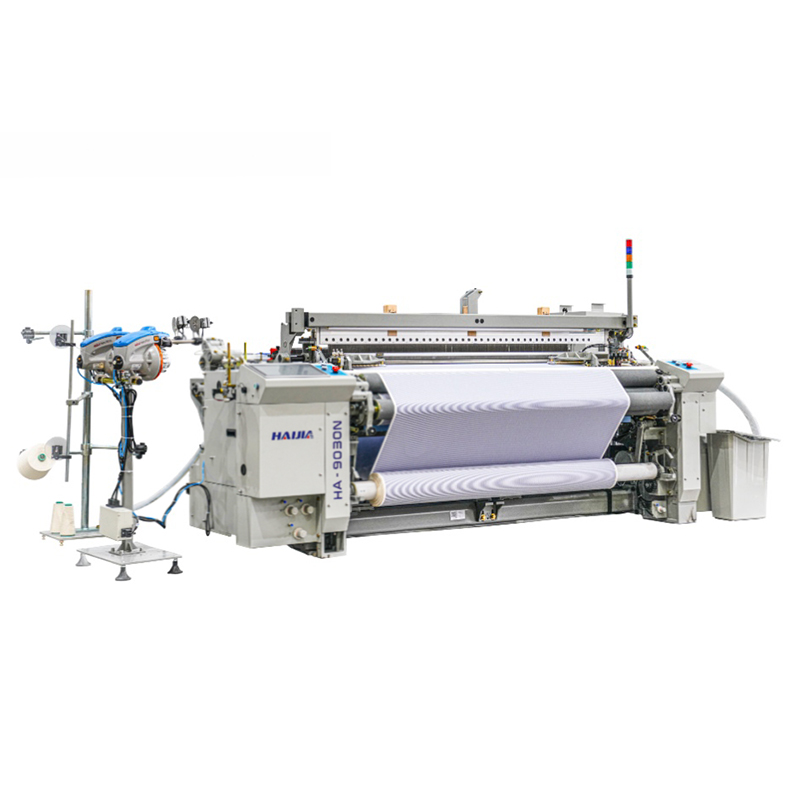
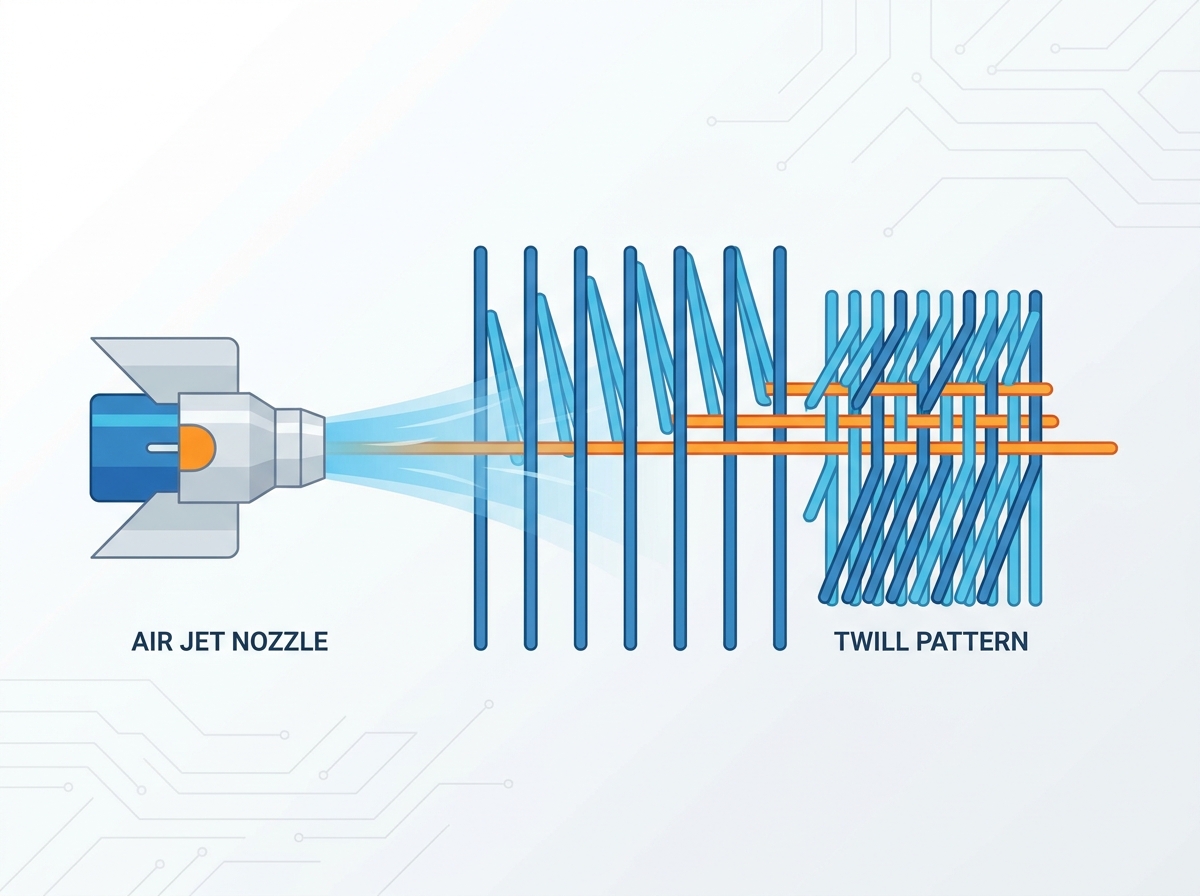
Using a targeted stream of compressed air propels the weft yarn across the shed. Unmatched weft insertion rates and speeds exceeding 1,000 picks per minute make the air jet loom the industry standard. It excels in high-volume, standardized twill production, such as uniform fabrics and standard denim. Because there are no heavy mechanical parts moving back and forth through the warp shed, vibration is reduced, and speeds can be pushed to the absolute physical limits of the yarn. The lack of mechanical wear parts also reduces ongoing replacement costs for rapiers or projectiles.
Technology | Insertion Medium | Max Speed (PPM) | Best Use Case |
|---|---|---|---|
Rapier | Rigid/Flexible Band | 500 - 700 | Novelty yarns, heavy wools, complex patterns |
Projectile | Metal Bullet | 300 - 500 | Extremely wide fabrics, technical textiles |
Pneumatic | Compressed Air | 1000 - 1200+ | High-volume denim, standard twills, sheeting |
Breaking down the manufacturing phases highlights how pneumatic machinery executes the complex twill structure. You must control every variable from the moment the yarn leaves the warping beam to the moment the finished fabric rolls onto the take-up mechanism.
Applying sizing agents to warp yarns during the slashing process is necessary. High speeds demand superior warp preparation. This preparation helps yarns withstand extreme dynamic tension, minimize hairiness, and prevent loom stops. We typically use a blend of modified starches and synthetic polymers like PVA (Polyvinyl Alcohol). The sizing encapsulates the yarn, laying down protruding fibers. If you run unsized or poorly sized yarn on a high-speed pneumatic machine, the friction of the adjacent warp ends rubbing together during shedding will shred the yarn. You will spend more time tying broken ends than actually weaving fabric.
Analyze incoming yarn for tensile strength and elongation properties.
Formulate a sizing recipe based on yarn count and fiber blend.
Apply the sizing solution at controlled temperatures to ensure proper penetration.
Dry the warp sheet uniformly to prevent sticking on the weaver's beam.
Cam shedding is ideal for simple, repetitive 2/1 or 3/1 twills at maximum speed. Cams are mechanically robust and can handle the intense vibration of running at 1,200 picks per minute. Dobby shedding is required for complex, multi-harness twill variations or herringbone patterns. An electronic dobby can control up to 16 or 20 harness frames, allowing for intricate diagonal reversals. However, adding more frames increases the mechanical load and often requires a slight reduction in overall machine speed to maintain stability.
Synchronization of the main nozzle, relay nozzles, and the profile reed is critical. Air flow is managed sequentially across the width of the machine. This management maintains weft yarn tension, preventing slack or looping in the twill pattern. The main nozzle accelerates the yarn into the shed. The relay nozzles fire in a precise sequence, creating a moving pocket of air that carries the yarn across the width. The profile reed acts as a physical channel, guiding the air and the yarn. If the relay nozzle timing is off by even a few milliseconds, the air stream will blow the yarn out of the channel, causing a mispick.
Beat-up involves the mechanical action of packing the inserted weft into the fell of the cloth. Electronic let-off and take-up motions maintain consistent pick density. Consistent density is critical for uniform diagonal wales. The let-off motion releases warp yarn from the beam at a precise rate. The take-up motion pulls the woven fabric away at an equally precise rate. The ratio between these two motions determines the picks per inch (PPI). If the let-off stutters, you will get a dense band in the fabric. If the take-up slips, you will get a thin band. Both are unacceptable defects in commercial twill.
Assessing the financial and operational realities of adopting pneumatic weaving for twill is essential. You are trading mechanical complexity for pneumatic complexity. This shift requires a different approach to facility management and cost calculation.
Analyzing the return on investment of high-speed production against the continuous energy draw of industrial air compressors is vital. High-volume runs have significant cost-per-meter implications. A modern weaving shed requires massive rotary screw compressors to supply clean, dry air at constant pressure. The electricity required to run these compressors often represents the largest single utility cost for the facility. You must calculate whether the increased yardage output offsets the higher energy bills. Optimizing nozzle pressure and minimizing air leaks in the distribution piping are daily operational priorities.
Cheap yarn carries hidden costs. Pneumatic insertion lacks mechanical grips. Weak or hairy yarns will blow apart or tangle. This causes machine downtime that negates the speed advantage. When you buy lower-grade yarn, you save money on procurement but lose it on the weaving floor. Every time a weft yarn breaks, the machine stops. An operator must intervene, clear the broken pick, and restart the machine. This downtime destroys your overall equipment effectiveness (OEE). Investing in yarn with excellent Uster statistics (low unevenness, high strength) is mandatory for profitable pneumatic weaving.
The shift from mechanical maintenance to pneumatic maintenance is significant. Operators must monitor air pressure drops, clean nozzles, and maintain compressor health instead of replacing physical shuttles or rapiers. Dust and lint are the enemies of pneumatic systems. If lint clogs a relay nozzle, the air flow is disrupted, and the machine will throw continuous weft stops. Daily cleaning schedules and strict adherence to air filtration maintenance are required to keep the machines running at peak efficiency.
Identifying the most common failure points when scaling twill production helps ensure success. You must anticipate problems before they cause massive amounts of off-quality fabric.
High-velocity air insertion risks snapping low-tensile weft yarns. Implementing automatic pick repair systems mitigates this risk. Maintaining strict incoming yarn quality control using Uster statistics is also necessary. You should establish clear minimum strength requirements for all incoming yarn lots. Reject any lot that falls below the threshold, as it will inevitably cause problems on the floor.
When a machine stops for a broken yarn and then restarts, the tension dynamics change momentarily. This change can cause a visible line in the fabric known as a starting mark. Modern machines use sophisticated software algorithms to adjust the let-off and take-up tension during the restart sequence to prevent this defect. You must calibrate these settings for every specific fabric style you run.
Producing premium twill fabrics requires precise control over weave structure, yarn quality, pneumatic weft insertion, and machine synchronization. By optimizing every stage of the weaving process—from warp preparation and shedding to tension control and quality monitoring—manufacturers can achieve higher productivity, lower defect rates, and consistent fabric quality while reducing long-term production costs.
Working with an experienced textile machinery manufacturer is equally important for ensuring reliable production performance and sustainable business growth. Haijia specializes in advanced air jet looms, water jet looms, and intelligent weaving solutions. With innovative engineering, strict quality control, and comprehensive technical support, we help textile manufacturers improve weaving efficiency, optimize fabric quality, and expand production capacity across denim, apparel fabrics, home textiles, technical textiles, and industrial fabric applications.
Audit your current yarn supply to ensure it meets the tensile strength requirements for pneumatic insertion.
Evaluate your facility's compressed air capacity and climate control systems before upgrading machinery.
Implement automated tension control systems to minimize defects during high-speed twill runs.
Train maintenance staff on pneumatic system troubleshooting rather than traditional mechanical repairs.
A: Twill weave uses an offset over-and-under pattern that creates diagonal lines called wales. This structure reduces interlacing points, allowing yarns to pack closer together. The result is a denser, heavier, and more durable fabric compared to the simple 1:1 grid of plain weave.
A: It offers extremely high weft insertion speeds, often exceeding 1,000 picks per minute. This allows for massive daily yardage output of standardized heavy twill fabrics like denim. The technology provides the necessary speed while maintaining consistent quality across long production runs.
A: The primary challenges include high energy consumption from industrial air compressors and the strict requirement for high-quality, uniform yarns. Weak or hairy yarns will blow apart under the high-velocity air stream, causing frequent machine stops and reducing overall efficiency.
A: The shedding mechanism determines the complexity of the twill. Cam shedding handles simple, repetitive patterns like 2/1 or 3/1 at maximum speeds. Dobby shedding systems are required to manage complex, multi-harness designs or intricate herringbone variations.
A: Right-hand twill features diagonal lines running upward from bottom-left to top-right. Left-hand twill lines run upward from bottom-right to top-left. The interaction between this directionality and the yarn's twist direction affects the fabric's final texture, softness, and drape.
A: Starting marks are prevented by utilizing advanced electronic let-off and take-up motions. These systems use software algorithms to precisely manage warp tension during machine stops and restarts, ensuring the pick density remains perfectly consistent across the interruption.