Tel: +86-532-83130887 Email: eiffel@qdhaijia.net

Views: 0 Author: Site Editor Publish Time: 2026-08-19 Origin: Site
Moving from a conceptual textile design to physical production requires absolute precision on the factory floor. Understanding the exact mechanics of fabric formation becomes a high-stakes operational requirement for any textile facility manager or engineer. Selecting the wrong fabric formation method or loom technology leads directly to compromised structural integrity. You will face inefficient production scaling, excessive machine downtime, and massive material waste. This guide serves as a technical evaluation framework. We will answer what is weaving beyond the basic definitions. You will learn how to analyze warp and weft mechanics, compare industrial loom technologies, and assess implementation realities for successful, large-scale textile production. We strip away the theory to focus on the mechanical realities of turning raw yarn into dimensionally stable fabric.
Weaving is the precise interlacing of two distinct sets of yarns (warp and weft) at right angles, dictating the fabric's tensile strength, drape, and durability.
The choice of weave structure (plain, twill, satin) directly correlates to the end-product's performance criteria and manufacturing complexity.
Scaling production requires transitioning from manual/frame looms to automated systems (rapier, air-jet, projectile), each carrying distinct capital expenditure and material compatibility trade-offs.
Effective weaving implementation hinges on mastering the warping process, warp spacing (density), and tension management to mitigate yarn breakage and machine downtime.
Table of Contents
Textile manufacturing relies heavily on dimensional stability. We define weaving as the orthogonal interlacing of threads. This precise grid structure provides superior resistance to deformation compared to knits. Woven fabrics hold their shape under severe mechanical stress, making them the standard for everything from heavy-duty workwear to industrial filtration systems. Success in weaving is measured by a fabric's ability to maintain its structural integrity without unwanted stretching, bias distortion, or seam slippage under load.
The warp (also known as ends) consists of longitudinal yarns pre-wound onto a large steel cylinder called the warp beam. These threads remain under high, continuous tension throughout the entire manufacturing process. Because they bear the brunt of the mechanical stress, warp yarns require exceptionally high tensile strength. Facilities routinely apply sizing treatments—such as starch, polyvinyl alcohol (PVA), or acrylic binders—to coat the warp yarns in a process called slashing. This sizing process smooths the yarn surface, glues down protruding fibers to reduce hairiness, and allows the threads to withstand constant loom friction without snapping.
The weft (referred to as picks or filling) involves the transverse yarns inserted horizontally across the loom. They travel over and under the tensioned warp. Your weft selection heavily influences the final texture, visual pattern, and lateral flexibility of the fabric. Because the weft does not endure the same extreme, continuous tension as the warp during production, you can utilize weaker, highly textured, or novelty yarns in the filling direction to achieve specific aesthetic or functional goals. Weft yarns are typically fed from stationary cones positioned on the side of the machine, passing through accumulators to ensure consistent delivery tension.
Every loom, regardless of its technological complexity, operates on three fundamental mechanical motions. These motions must synchronize perfectly to produce defect-free fabric at high speeds.
Shedding involves the mechanical separation of warp threads. The loom lifts specific warp yarns while lowering others using devices called heddles, which are mounted in frames called harnesses. Each warp thread passes through the eye of a single heddle. By raising and lowering specific harnesses, the machine creates a temporary, geometric pathway known as the shed. The complexity of the shedding mechanism (cam, dobby, or jacquard) dictates the complexity of the pattern you can weave.
Picking is the actual insertion of the weft yarn. The loom passes the filling yarn straight through the open shed from one side of the machine to the other. Depending on the loom type, this insertion happens via wooden shuttles, metal rapiers, blasts of compressed air, or high-pressure water jets. The speed of this motion is measured in Weft Insertion Rate (WIR), which dictates the overall production capacity of the machine.
Beating-up secures the woven structure. A heavy, comb-like device called the reed swings forward to push the newly inserted weft yarn tightly against the already woven fabric. This leading edge of the fabric is known as the fell. The warp threads pass through the empty spaces in the reed, known as dents. Beating-up ensures structural density, locks the threads into their designated grid positions, and determines the final tightness of the weave.
Fabric density dictates material performance. We measure this density using Ends Per Inch (EPI) and Picks Per Inch (PPI). EPI measures the horizontal spacing of the warp threads, while PPI measures the vertical stacking density of the weft threads. Together, they determine the fabric's cover factor.
Calculating and adjusting your EPI and PPI directly dictates the final fabric weight, opacity, breathability, and structural integrity. A high EPI combined with a high PPI yields a tight, wind-resistant, and highly durable fabric like canvas. Conversely, a low PPI results in a looser, more breathable drape suitable for summer apparel or medical gauze. Adjusting these numbers requires swapping out the reed for a different dent count and altering the loom's electronic take-up speed.
Standard Fabric Density Configurations
Fabric Type | Typical EPI | Typical PPI | Structural Characteristics |
|---|---|---|---|
Heavy Canvas | 40 - 60 | 30 - 40 | High rigidity, excellent puncture resistance, low drape. |
Standard Denim | 60 - 70 | 40 - 50 | Warp-faced durability, moderate drape, high abrasion resistance. |
Cotton Muslin | 40 - 50 | 40 - 50 | Balanced structure, high breathability, low mechanical strength. |
Medical Gauze | 20 - 30 | 15 - 25 | Extremely loose grid, high fluid absorption, zero structural rigidity. |
Woven fabrics fall into three distinct structural categories based on yarn visibility and dominance on the fabric surface. Plant managers must select the correct category based on the intended mechanical application of the textile.
Balanced weaving shows equal visibility of both warp and weft yarns. The interlacing distributes the physical wear evenly across both sets of threads. Manufacturers use this standard, highly stable approach for shirting, sheeting, and basic apparel fabrics. It requires equal tension management on both axes.
Warp-faced structures push the longitudinal yarns to the surface, hiding the weft beneath them. Denim serves as the classic industrial example. The warp dominance increases abrasion resistance on the face of the fabric, making it ideal for rugged environments where the surface takes constant friction. This structure requires a significantly higher EPI than PPI.
Weft-faced structures hide the warp entirely. Heavy rugs and certain upholstery fabrics utilize this method. The weft yarns dominate the aesthetic output, providing a distinct horizontal texture and allowing for intricate, multi-colored transverse patterns. This requires packing the weft yarns incredibly tight during the beating-up phase, demanding a heavy, reinforced reed.
Understanding what is weaving requires analyzing the specific interlacing patterns used to lock the yarns together. Three primary structures dominate global textile manufacturing, each offering distinct mechanical advantages and requiring different loom configurations.
Plain weave uses a simple, alternating 1:1 interlacing ratio. The weft passes over one warp yarn and immediately under the next. This creates a tight, checkerboard-like grid. Mechanically, this is the simplest structure to produce, requiring only two harnesses on the loom to create the shed.
This structure offers maximum structural integrity and highly cost-effective production. It resists unravelling better than any other weave due to the high frequency of thread intersections. However, plain weave severely limits fabric drape. It also generally exhibits lower tear strength because the tightly locked yarns cannot shift to absorb localized force, causing them to snap under concentrated pressure. The high number of intersections also creates maximum friction during weaving, requiring excellent warp sizing.
Twill weave creates a distinct diagonal rib or wale across the fabric surface. This happens through staggered interlacing, where the weft floats over multiple warp yarns (usually two or three) before going under one. Producing a basic twill requires a minimum of three to four harnesses on the loom.
Twill delivers superior soil resistance and allows manufacturers to pack yarns much closer together, achieving higher density than plain weave. The fewer interlacing points provide better drape, increased flexibility, and significantly higher tear strength. The yarns can shift slightly under stress to distribute mechanical loads. This makes twill the ideal choice for heavy-duty applications like workwear, denim, and durable upholstery.
Satin weave utilizes exceptionally long floats. The yarns skip over four, five, or even up to eleven perpendicular threads before finally interlacing. This minimizes the visible intersection points on the surface. Weaving satin requires complex shedding mechanisms, typically utilizing five to eight harnesses.
This structure creates a high aesthetic value, brilliant light reflection, and an incredibly smooth hand-feel. The fabric drapes beautifully around complex shapes. However, the long, exposed floats make satin highly susceptible to snagging, pilling, and abrasion. It remains a poor choice for high-friction environments and is generally reserved for luxury apparel, linings, and decorative interior textiles. The lack of frequent interlacing also means the fabric can suffer from seam slippage if not sewn carefully.
Transitioning from concept design to full-scale manufacturing requires selecting the right hardware. The loom technology you deploy dictates your production speed, energy consumption, and material capabilities. You cannot force a loom to weave a yarn it was not designed to handle.
Rigid heddle, table, and floor looms operate entirely manually. The weaver controls the warp tension by hand and actuates the shedding mechanism using foot pedals (treadles). The picking is done by physically throwing a wooden shuttle containing a bobbin of weft yarn across the warp.
These looms excel in research and development, bespoke textile creation, and proof-of-concept prototyping. They allow textile engineers to test yarn interactions, sizing recipes, and weave structures quickly without massive setup costs. However, they suffer from severe commercial limitations. You face exceptionally low throughput, high labor costs per yard, and manual tension inconsistencies that ruin large production runs. They are strictly for the lab, not the factory floor.
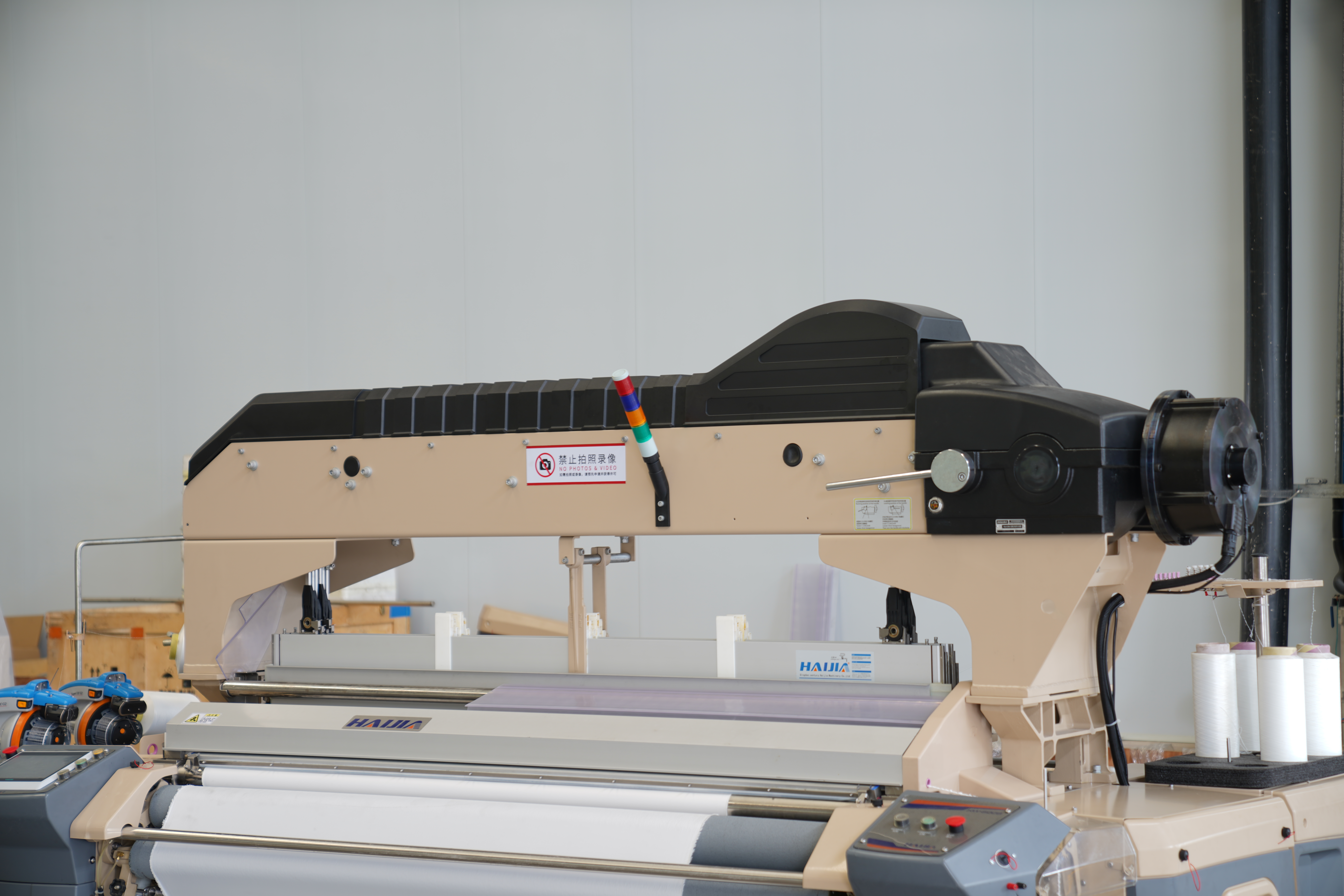
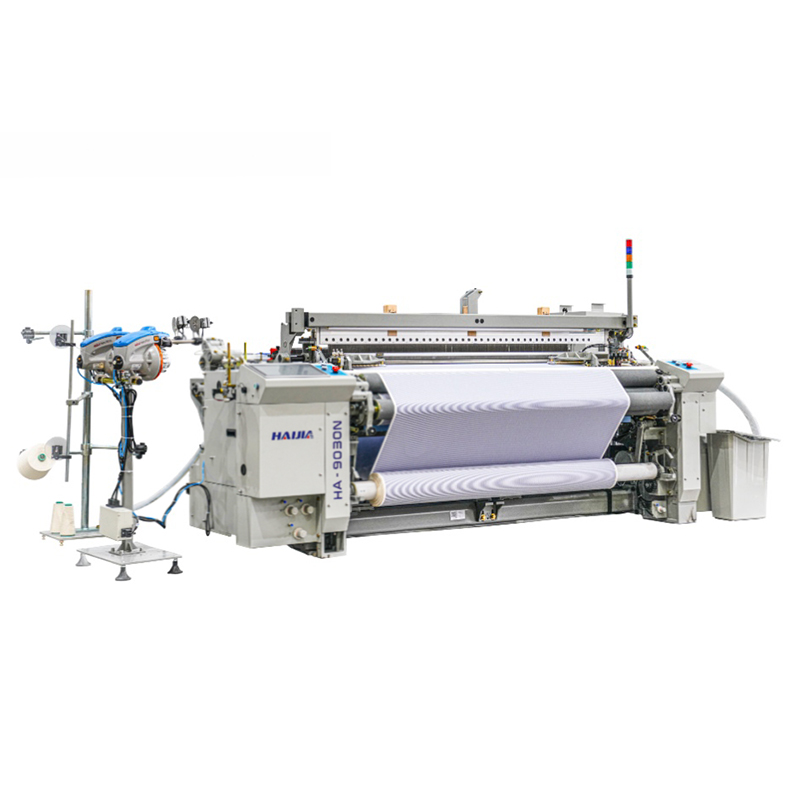
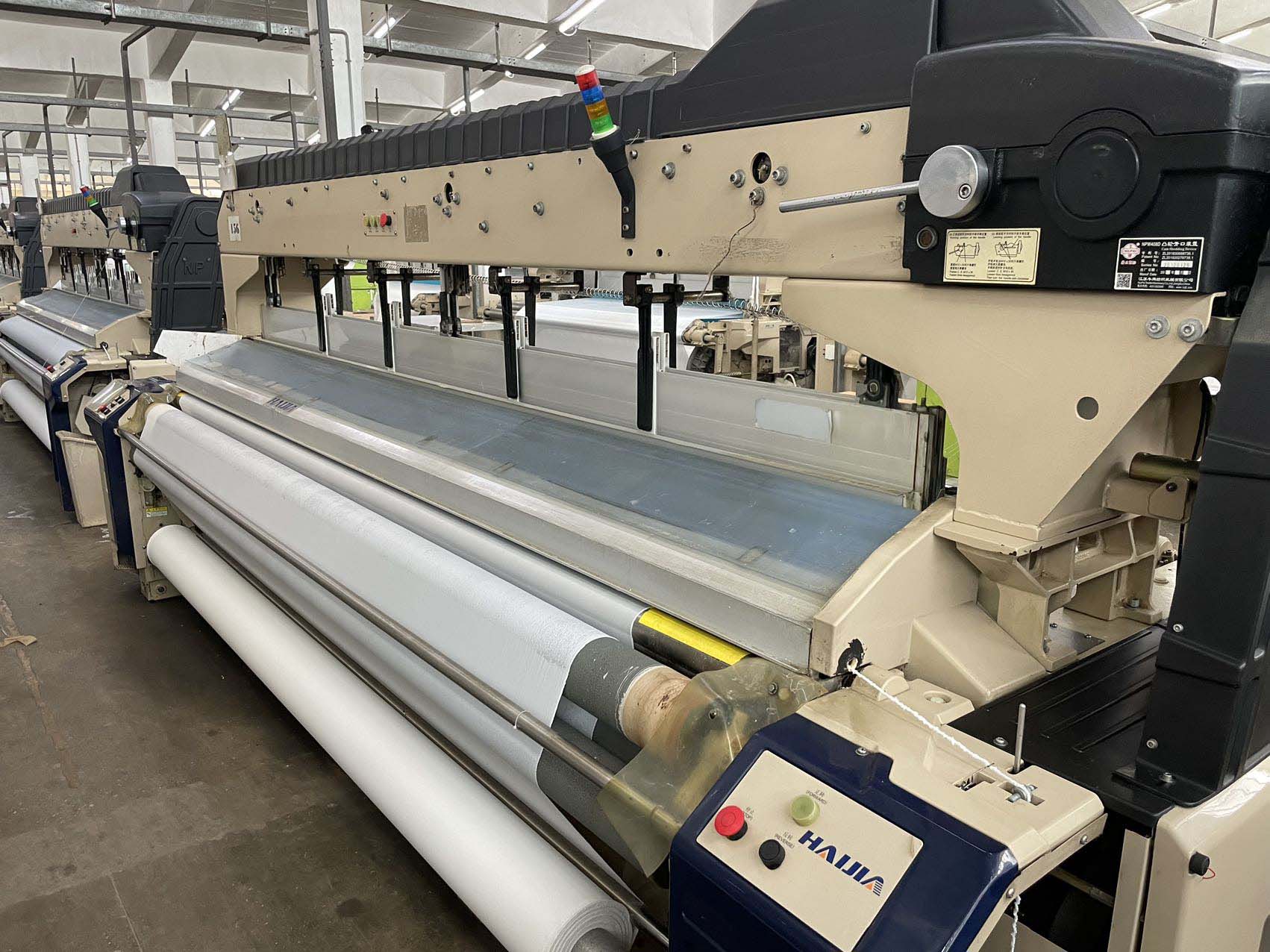
Industrial shuttleless looms automate the shedding, picking, and beating-up motions for massive scale. They operate at hundreds of picks per minute, utilizing electronic let-off and take-up motions to maintain perfect tension.
Rapier looms offer incredible versatility. They use a rigid rod or flexible tape to carry the weft across the shed. Positive rapiers actively grip the yarn, while negative rapiers rely on tension. They easily handle complex, heavy, highly textured, or delicate yarns. While they operate at moderate speeds (400 to 700 picks per minute) compared to other industrial options, their ability to weave intricate patterns with up to 12 different weft colors makes them indispensable for fashion, upholstery, and technical textiles.
Air-jet looms push production speed to the absolute limit. They use a precisely timed blast of compressed air from a main nozzle, assisted by relay nozzles and a specialized profile reed, to propel the weft across the shed. They work perfectly for standard, lightweight, high-volume fabrics like cotton sheeting and apparel linings. They achieve speeds exceeding 1200 picks per minute. However, they consume massive amounts of energy to generate compressed air and only work with highly uniform, strong yarn types. Hairy or weak yarns will blow apart in the air stream.
Projectile looms utilize a small, bullet-like metal clamp to drag the weft across the warp. A torsion bar fires the projectile through guide teeth. They excel at producing incredibly wide-width fabrics, heavy denims, and technical textiles like geotextiles. They require high initial capital investment but deliver excellent long-term reliability and handle heavy mechanical loads effortlessly. They generate less waste at the selvedge compared to rapier looms.
Loom Technology Decision Matrix
Technology | Yarn Compatibility | Production Speed | Ideal Application |
|---|---|---|---|
Rapier | High (Delicate to Heavy) | Moderate (400-700 ppm) | Fashion apparel, upholstery, complex multi-color patterns |
Air-Jet | Low (Uniform, strong yarns) | Very High (800-1200+ ppm) | Standard sheeting, lightweight cottons, high-volume linings |
Projectile | Moderate (Technical yarns) | High (300-500 ppm, wide width) | Wide-width textiles, geotextiles, heavy industrial fabrics |
Fabric formation extends beyond the loom. You must evaluate how woven materials compare mechanically and operationally to other manufacturing methods to ensure you choose the right process for your end product. Each method requires entirely different machinery, factory layouts, and operator skill sets.
Weaving provides exceptional dimensional stability. The orthogonal grid locks yarns firmly in place, distributing tensile loads evenly across the fabric surface. Knitting relies on a continuous series of interlocking loops created by latch or spring beard needles. This looped structure creates inherent, multi-directional stretch and high recovery, even when using rigid yarns.
Operationally, knitting generally requires significantly less setup time. You do not need to prepare a massive warp beam; you simply feed cones of yarn directly into the circular or flatbed knitting machine. Knitting allows for rapid pattern changes via digital controllers. However, knits offer far less structural rigidity. Woven fabrics hold heavy loads, resist stretching out of shape, and provide superior wind and puncture resistance. You choose weaving when structure, load-bearing capacity, and durability outweigh the need for stretch and rapid prototyping.
Weaving uses mechanical interlacing to build fabric strength over time, requiring extensive yarn preparation. Non-wovens bypass yarn creation entirely. They rely on the chemical, thermal, or mechanical bonding (such as needlepunching or hydroentangling) of loose, unspun fibers directly into a web.
Woven fabrics offer superior long-term durability, high tensile strength, and the ability to survive repeated, aggressive washing cycles. Non-wovens produce fabric at astonishing speeds and extremely low costs. However, non-wovens are almost exclusively optimized for single-use applications, specialized filtration, or medical garments where lifecycle longevity matters far less than immediate barrier properties and disposability. You cannot use non-wovens for load-bearing apparel or heavy-duty upholstery.
Scaling a weaving operation introduces significant technical hurdles. Facility managers must prepare for complex setup phases, strict environmental requirements, and heavy infrastructure demands to maintain profitability and prevent catastrophic machine failure.
Dressing the loom remains the most labor-intensive and mathematically rigorous phase of textile production. Warping requires the precise alignment of hundreds or thousands of individual ends from a massive creel onto a warp beam. Every single thread must pass through specific drop wires, heddle eyes, and reed dents in a precise sequence. A single crossed thread or miscalculation ruins the entire fabric roll, creating a defect known as a warp streak.
To mitigate this massive operational risk, facilities must invest in automated warping mills. Sectional warping techniques become mandatory for mid-to-high volume production, especially for complex striped patterns. These mechanical upgrades drastically reduce machine downtime, ensure uniform tension across the beam, and eliminate human error during the critical setup phase. You must also install static eliminators on the creel to prevent synthetic yarns from tangling during the high-speed winding process.
Uneven warp tension causes severe structural defects. It leads directly to fabric puckering, broken ends, inconsistent density, and rejected fabric rolls. The violent shedding and beating-up motions place immense stress on the yarn. If the electronic let-off motion fails to release the warp at the exact right microsecond, the threads will snap under the strain.
You must implement strict environmental controls within the weaving shed. Maintaining consistent facility humidity (typically between 65% and 80% relative humidity) prevents natural yarns like cotton from drying out, becoming brittle, and snapping mid-production. For synthetic yarns, high humidity prevents the buildup of static electricity, which causes yarns to repel each other and miss the heddle eyes. Furthermore, executing a proper yarn sizing application ensures the warp maintains its tensile strength and resists abrasion during the high-speed weaving process.
Industrial looms require massive initial capital outlays. You must balance this heavy expenditure against your expected production yield and facility infrastructure. You cannot simply drop a high-speed loom onto a standard warehouse floor.
Air-jet looms produce fabric rapidly but carry enormous energy consumption demands due to the continuous need for compressed air generation. You must install industrial-grade rotary screw compressors and extensive pneumatic piping. High-speed machines generate intense vibration, requiring reinforced concrete flooring with specialized vibration isolation mounts. They demand highly skilled technicians to calibrate the picking timing perfectly, adjust the shed geometry, and prevent catastrophic machine downtime. You must factor in routine maintenance, spare parts inventory, and specialized operator training when planning your facility layout.
Audit your facility's compressed air infrastructure and concrete floor load capacity before procuring high-speed air-jet machinery.
Conduct a small-scale prototype run on a manual floor loom to test yarn friction resistance and sizing recipes before scaling.
Calculate your required Ends Per Inch (EPI) and Picks Per Inch (PPI) meticulously to finalize accurate material purchasing volumes and minimize yarn waste.
Implement automated environmental controls to maintain 65% to 80% relative humidity in the production shed to prevent yarn breakage.
Install electronic warp stop motions and drop wires on all industrial looms to immediately halt production if a single warp thread snaps.
For textile manufacturers moving from process planning to industrial-scale weaving, Qingdao Haijia Machinery Co.,Ltd. provides integrated shuttleless weaving solutions backed by R&D, manufacturing, marketing, and after-sales service capabilities. With long-term expertise in water jet and air jet loom development, Haijia supports textile producers in improving weaving efficiency, production consistency, and equipment reliability across demanding manufacturing environments.
A: The warp consists of vertical yarns held under constant, high tension on the loom. The weft refers to the horizontal yarns inserted over and under the tensioned warp to build the actual fabric structure.
A: Plain weave offers the most interlacing points, making it highly stable and resistant to unravelling. However, twill weave offers better tear strength because the slightly looser yarns can shift under stress to absorb concentrated force without snapping.
A: A loom is a mechanical device that holds warp threads under tension. It facilitates fabric creation through three synchronized motions: shedding (separating warp threads), picking (inserting the weft), and beating-up (pushing the weft tightly into the fabric).
A: Woven fabrics lack inherent stretch and flexibility. Weaving also requires significantly longer setup times due to the complex, labor-intensive warping process. Making structural pattern changes takes much more time than reprogramming a digital knitting machine.
A: A warp-faced weave is a specific structure where the longitudinal warp yarns completely cover the horizontal weft yarns on the face of the fabric. Denim is the most common industrial example of this technique.
A: You measure fabric density using Ends Per Inch (EPI) for the warp and Picks Per Inch (PPI) for the weft. Counting the number of individual threads within a one-inch square determines the fabric's structural tightness and weight.