Tel: +86-532-83130887 Email: eiffel@qdhaijia.net

Views: 0 Author: Site Editor Publish Time: 2026-08-19 Origin: Site
Transitioning from manual weaving infrastructure to high-speed, automated production marks a major operational shift for textile facility managers. Scaling output requires balancing high production volumes, strict fabric consistency, and complex pattern capabilities against capital expenditure, energy consumption, and maintenance overhead. Solving this bottleneck means moving away from human-powered mechanisms and adopting robust, mechanized solutions.
The power loom serves as the foundational automated weaving device in modern textile manufacturing. By replacing manual effort with synchronized electromechanical systems, these machines drastically increase production rates while minimizing human error. Selecting the correct loom type and understanding its underlying mechanical principles are essential steps for maximizing return on investment and minimizing operational downtime on the factory floor.
Mechanization Drives Scale: Power looms replace human-coordinated movements with precise interactions of levers, cams, and gears, exponentially increasing production speed and fabric uniformity.
Categorical Trade-offs: The choice between traditional shuttle looms (plain or automatic) and modern shuttleless variants (Air-Jet, Rapier, Water-Jet) dictates production capacity, energy consumption, and fabric versatility.
Operational Considerations: While power looms offer significant advantages in output, buyers must account for infrastructure upgrades, continuous power supply requirements, and specialized operator training.
Application Specificity: No single power loom fits all use cases; procurement decisions must align strictly with the target fabric weight, yarn type, required weave complexity (e.g., Dobby or Jacquard), and budget constraints.
Table of Contents
A power loom is an industrial weaving machine that automates the interlacing of warp and weft threads to produce fabric. Unlike handlooms that rely on human physical exertion to drive the weaving cycle, mechanized looms utilize electrical power sources and heavy-duty drive motors. This automation ensures continuous, high-speed operation, transforming raw yarn into finished textiles with minimal direct human intervention.
The origin of this technology dates back to the Industrial Revolution. Edmund Cartwright designed the first mechanized loom in the 1780s, effectively shifting textile production from a decentralized cottage craft to centralized, mass industrial manufacturing. Early iterations relied on water wheels or steam engines via complex line shaft systems. Today, individual high-torque electric motors drive these machines, offering precise control over speed, tension, and pattern execution.
Understanding the anatomy of the machine requires looking at how human hand-and-eye coordination is replicated mechanically. The core structure consists of a robust cast-iron or heavy steel frame supporting various rotating beams, harnesses, and beating mechanisms. Precision relies on the synchronized interaction of levers, cams, and gears. Cams convert rotary motion into the linear strokes needed to lift threads, while gears ensure the fabric advances at an exact rate. Modern variations integrate electronic sensors, variable frequency drives (VFDs), and servomotors to replace older mechanical linkages, further increasing reliability and operational speed.
Factory floors must accommodate the intense kinetic energy generated by these machines. The beating motion creates significant vibration, requiring specialized dampening pads and reinforced concrete foundations. Operators must maintain strict lubrication schedules for all moving parts, as the friction generated at speeds exceeding 800 picks per minute can quickly degrade metal components if left unmanaged.
The weaving process on a mechanized loom follows a strict, repetitive cycle based on the 360-degree rotation of the main drive shaft. This cycle is divided into primary, secondary, and auxiliary motions. Each motion must execute flawlessly to prevent yarn breakage and fabric defects.
The primary motions are responsible for the actual interlacing of the warp (lengthwise) and weft (crosswise) threads. This sequence happens hundreds of times per minute.
Shedding: This is the mechanical separation of the warp threads into two distinct layers, creating a temporary tunnel called the shed. The shedding mechanism determines the fabric pattern. Tappet shedding uses simple cams and is ideal for basic weaves like plain or twill. Dobby shedding controls a larger number of heald shafts, allowing for complex geometric patterns. Jacquard shedding controls individual warp threads via a harness tied to a specialized head, enabling highly intricate, non-geometric designs.
Picking: Once the shed is open, the picking motion inserts the weft thread through the gap. Depending on the loom type, this insertion is achieved using a wooden shuttle, a mechanical rapier, a burst of compressed air, or a pressurized stream of water. Timing is critical; picking usually occurs between 90 and 270 degrees of the main shaft rotation.
Beating-Up: Immediately after the weft thread passes through the shed, a comb-like device called the reed swings forward. The reed pushes the newly inserted weft yarn tightly into the already woven fabric, known as the fell of the cloth. This action determines the density and structural integrity of the textile.
For the primary motions to continue uninterrupted, the machine must constantly feed new yarn and collect the finished fabric. These are the secondary motions.
Let-Off Mechanism: This system controls the unwinding of the warp yarn from a large cylinder called the warp beam. It must release the yarn at a precise rate while maintaining constant, uniform tension. Modern electronic let-off systems use load cells to monitor tension continuously, adjusting the beam rotation speed via servomotors.
Take-Up Mechanism: Operating in strict synchronization with the let-off motion, the take-up mechanism winds the newly woven cloth onto a cloth roller. The speed of the take-up roller dictates the number of weft threads per inch (pick density), directly impacting the fabric weight and texture.
Auxiliary mechanisms act as the machine's nervous system, preventing catastrophic failures and ensuring high-quality output.
Warp Stop Motions: These sensors monitor thread integrity. The system utilizes small metal drop wires suspended on each warp thread. If a thread breaks, the wire drops, completing an electrical circuit that instantly halts the machine.
Weft Stop Motions: Optical or piezoelectric sensors detect if the weft yarn fails to cross the shed completely. The machine stops before a missing pick creates a visible flaw in the fabric.
Protective Devices: Mechanical safeguards prevent collisions. Warp protector motions detect if a shuttle or rapier gets trapped inside the shed. If the insertion device fails to clear the warp threads in time, the mechanism stops the reed from beating up, preventing massive warp thread breakage.
Selecting the right equipment requires evaluating the specific insertion technology. Looms are broadly categorized into traditional shuttle looms and modern shuttleless systems. Facility managers must match the machine type to their specific production goals and infrastructure capabilities.
Shuttle looms represent the older generation of mechanized weaving, utilizing a wooden or composite shuttle carrying a small bobbin (pirn) of weft yarn.
Plain vs. Automatic: Early plain looms require the operator to manually stop the machine and replace the weft pirn once it runs empty. Automatic shuttle looms feature a mechanical replenishment system that ejects the empty pirn and inserts a full one without halting the weaving cycle.
Operational Realities: These machines are highly affordable and relatively simple to maintain, making them accessible for beginner textile operations. However, they operate at much lower speeds, generate extreme noise levels, and are limited in fabric width due to the physics of throwing a heavy shuttle across the machine.
Shuttleless looms eliminate the heavy shuttle, inserting the weft directly from large, stationary cones. This reduction in moving mass allows for exponentially higher speeds and wider fabric production.
Rapier Looms: These machines use rigid or flexible rods (rapiers) to carry the weft across the shed. One rapier brings the yarn to the center, where it is transferred to a second rapier that pulls it the rest of the way. Rapier looms handle heavy, delicate, or highly textured yarns with ease and can seamlessly switch between multiple weft colors.
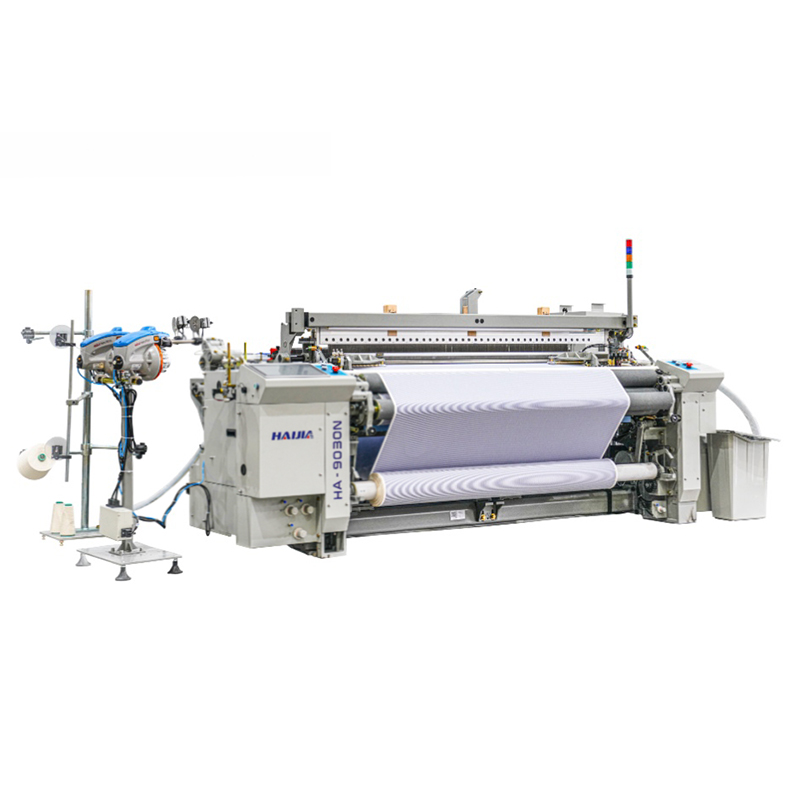
Air-Jet Looms: Weft insertion is achieved using a precisely timed burst of compressed air from a main nozzle, assisted by relay nozzles across the width of the machine. Air-jet technology offers extremely high production speeds. It is generally limited to standard, lighter fabrics and spun yarns. The reliance on continuous compressed air requires heavy-duty industrial compressors.
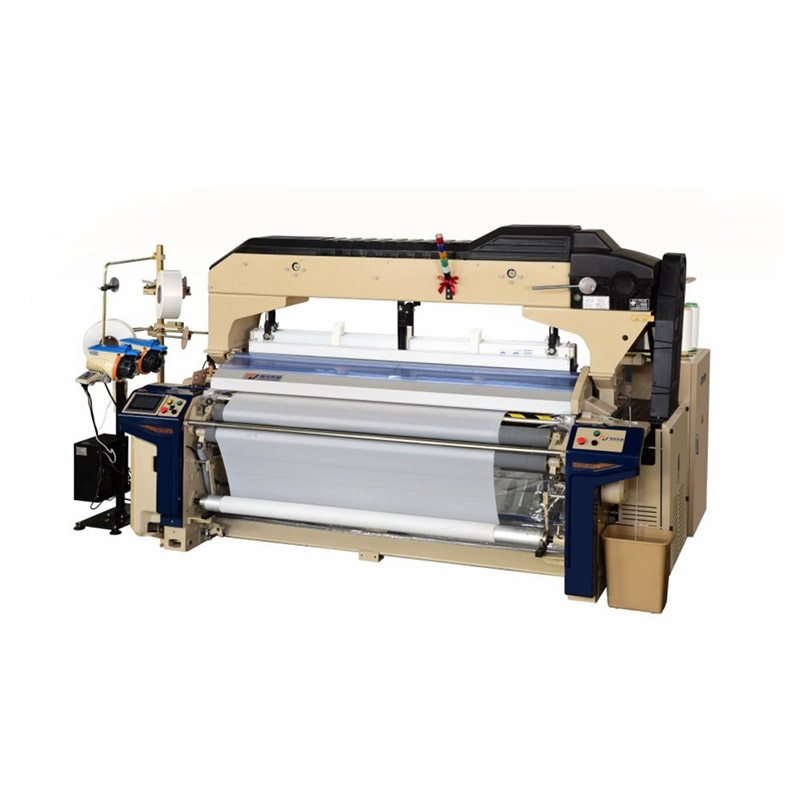
Water-Jet Looms: Similar to air-jets, these machines use a pressurized stream of water to carry the weft thread. They are highly efficient, fast, and consume less energy than air-jets. They are strictly limited to weaving synthetic, hydrophobic fibers like polyester and nylon. Natural fibers like cotton would absorb the water, swell, and snap.
Projectile Looms: These utilize small, bullet-like metal projectiles equipped with grippers to pull the weft yarn across the shed. Projectile looms excel at producing ultra-wide fabrics and are highly favored for heavy industrial textiles, denim, and technical fabrics.
Table: Comparison of Modern Weaving Technologies
Insertion Method | Primary Mechanism | Best Suited For | Relative Speed (PPM) |
|---|---|---|---|
Shuttle (Automatic) | Wooden/Composite Shuttle | Basic fabrics, narrow widths, heritage textiles | 150 - 250 |
Rapier | Flexible or Rigid Rods | High-fashion, multi-color, complex patterned fabrics | 400 - 700 |
Air-Jet | Compressed Air Nozzles | Standard cottons, blended apparel, high-volume sheeting | 800 - 1200+ |
Water-Jet | Pressurized Water Pump | 100% Synthetic fibers (Polyester, Nylon) | 600 - 1000 |
Projectile | Metal Gripper Projectiles | Ultra-wide fabrics, heavy denim, industrial textiles | 300 - 500 |
The application of a power loom is dictated by its insertion mechanism and shedding capabilities. Different sectors of the textile industry rely on specific machine configurations to meet their product standards. Facility managers must align their machinery procurement with the exact demands of their target market.
The fashion and apparel sector demands high volumes, rapid turnaround times, and frequent design changes. Air-jet looms dominate the mass production of standard cotton, silk, and blended apparel fabrics like shirting and lightweight twills due to their sheer speed. Manufacturers producing basic t-shirt fabrics or standard denim rely heavily on the high picks-per-minute output of air-jet systems.
Conversely, rapier looms are heavily utilized for premium fashion lines. Their ability to handle diverse yarn types and up to 12 different weft colors allows manufacturers to weave complex tartans, textured suitings, and intricate dress materials without extensive machine reconfiguration. When a fashion brand requires a heavy wool blend interwoven with a delicate metallic thread, the rapier loom is the only viable option.
Home textiles require robust machinery capable of handling heavy yarns and dense pick counts. Manufacturing heavy drapery, durable upholstery, and premium bed linens relies on rapier and projectile looms. These machines are frequently paired with electronic Jacquard attachments to weave large, non-repeating floral or damask patterns directly into the fabric structure.
The heavy beat-up force of these looms ensures the resulting fabric is tight, durable, and structurally sound for daily household wear. Towel manufacturing, for example, requires specialized terry looms equipped with secondary warp beams to create the characteristic looped pile, a process that demands precise tension control and heavy mechanical stability.
Beyond consumer goods, mechanized weaving is critical for industrial applications. Specialized projectile and rapier looms are engineered to weave technical textiles. These include geotextiles used in civil engineering for soil stabilization, heavy-duty canvas for military applications, and fiberglass fabrics utilized in aerospace and automotive composite materials.
These applications demand absolute structural uniformity and the ability to weave high-tenacity synthetic yarns without inducing friction damage during the insertion process. Kevlar weaving for ballistic vests requires extreme tension control to ensure the aramid fibers do not degrade during the beat-up phase. Projectile looms, with their precise gripper mechanisms, excel in these high-stakes manufacturing environments.
Replacing manual processes or upgrading from obsolete shuttle technology to modern shuttleless systems yields immediate and measurable operational benefits. Facility managers must track specific metrics to validate the performance of their weaving departments.
The most prominent advantage is the exponential increase in production speed, measured in Picks Per Minute (PPM). While a skilled handloom weaver might achieve 40 to 60 PPM, and an older shuttle loom reaches 150 to 200 PPM, modern air-jet looms routinely exceed 1,000 PPM. This massive leap in speed allows textile facilities to fulfill large-scale commercial orders in a fraction of the time, directly increasing revenue capacity and market responsiveness.
Human fatigue leads to variations in beating force and tension, resulting in fabric defects. Automated let-off and take-up mechanisms ensure uniform warp tension from the beginning of the beam to the end. Synchronized beat-up motions guarantee a consistent pick density. Electronic stop motions instantly halt the machine upon thread breakage, virtually eliminating major weaving flaws like missing picks or warp streaks. This consistency drastically reduces waste and increases the yield of premium-grade fabric, often measured using the standard 4-point inspection system.
Modern equipment provides manufacturers with the agility to pivot based on market trends. By swapping cam profiles, reprogramming electronic dobbies, or updating Jacquard design files via network connections, a facility can transition from weaving plain sheeting to complex twills or patterned fabrics rapidly. This versatility prevents machinery from sitting idle when consumer preferences shift.
Mechanization fundamentally shifts the role of the worker from a manual laborer to a machine supervisor. Because the primary and secondary motions are entirely automated, and stop motions alert operators to specific issues via indicator lights, a single trained technician can manage multiple machines simultaneously. In modern facilities, one operator might oversee 10 to 30 air-jet looms, drastically reducing the labor hours required per meter of finished fabric.
Procuring and installing industrial weaving equipment requires careful planning. Facility managers must evaluate several operational realities before committing to a specific technology. Failing to prepare the factory environment will result in frequent machine breakdowns and substandard fabric quality.
Buyers must heavily weigh ongoing operating expenses. Air-jet looms require massive, continuous volumes of clean, compressed air. This necessitates the installation of heavy-duty industrial compressors, refrigerated air dryers, and extensive piping networks, all of which draw significant electrical power. Water-jet looms require continuous water supply and on-site water treatment and filtration systems to recycle the water and manage effluent. Rapier looms may incur higher costs for spare parts due to the mechanical wear on the rapier heads, guide teeth, and drive wheels.
Modern looms cannot be dropped onto any factory floor. They require specific infrastructure modifications to operate at peak efficiency.
Space and Layout: High-speed looms generate substantial kinetic energy. Factory floors must be heavily reinforced to dampen vibrations, preventing structural damage to the building and ensuring the machines remain calibrated. Adequate spacing is required for operators to maneuver heavy warp beams and cloth rolls using overhead cranes or specialized forklifts.
Climate Control: Weaving efficiency is highly dependent on ambient conditions. Natural fibers like cotton are prone to snapping if the air is too dry. Facilities utilizing air-jet or rapier looms for natural fibers must install robust HVAC and humidification systems to maintain strict relative humidity (RH) levels—typically between 70% and 75% for cotton—preventing static buildup and yarn breakage.
Transitioning to modern shuttleless systems requires a shift in workforce capabilities. The maintenance of these machines moves away from traditional mechanical tinkering toward electromechanical troubleshooting. Facilities must invest in specialized training for their technicians to manage complex electronic sensors, variable frequency drives, and computerized control panels.
Table: Standard Weaving Machine Maintenance Schedule
Maintenance Task | Frequency | Responsible Personnel |
|---|---|---|
Clean optical weft sensors and drop wires | Daily (per shift) | Machine Operator |
Check and adjust warp tension load cells | Weekly | Shift Technician |
Lubricate main drive shaft and cam profiles | Bi-Weekly | Maintenance Team |
Inspect rapier tapes/heads for abrasion wear | Monthly | Maintenance Team |
Calibrate air compressor pressure and drain lines | Monthly | Facility Engineer |
Conduct a comprehensive facility energy and infrastructure audit to ensure sufficient power, flooring stability, and climate control capabilities before selecting a machine type.
Request fabric-specific trial runs from machinery manufacturers using your exact yarn specifications to verify operational speeds and defect rates.
Evaluate the availability of local technical support and the lead times for critical electromechanical spare parts to prevent extended downtime.
Assess the training requirements for current staff and implement a structured upskilling program focused on computerized machine management and sensor troubleshooting.
Selecting the right weaving equipment requires not only understanding machine performance but also partnering with an experienced manufacturer that can provide reliable technology support and customized solutions. Qingdao Haijia Machinery Co.,Ltd. focuses on textile machinery development and manufacturing, providing professional weaving equipment solutions for global textile producers with a commitment to stable performance, efficient production, and long-term customer support.
A: A handloom is operated entirely by human physical effort, using hands and feet to drive the shedding, picking, and beating motions. A mechanized loom automates these identical processes using electric motors and mechanical linkages, resulting in significantly higher speeds, continuous operation, and uniform fabric quality without operator fatigue.
A: A plain loom requires the operator to manually stop the machine to replace the weft yarn bobbin once it runs out. An automatic loom features a mechanical sensor and replenishment system that automatically ejects the empty bobbin and inserts a full one without stopping the weaving cycle.
A: Electricity consumption varies heavily by type. Rapier and projectile looms generally consume between 3 to 7 kW per hour. Air-jet looms consume significantly more energy because they require large, external industrial air compressors to generate the continuous high-pressure air bursts needed for weft insertion.
A: Primary motions (shedding, picking, beating-up) interlace the threads to create fabric. Secondary motions (let-off, take-up) continuously feed raw yarn and roll up the finished cloth. Auxiliary motions (stop motions, protectors) act as safety and quality control systems, halting the machine if threads break.
A: The air-jet loom is currently the fastest commercial weaving machine available. By using a burst of compressed air to shoot the weft thread across the shed, it eliminates heavy moving parts. Modern air-jet looms can easily exceed production speeds of 1,000 to 1,200 picks per minute on standard fabrics.
A: No single machine weaves everything efficiently. Rapier looms are the most versatile, handling delicate silks, heavy wools, and textured yarns. Water-jet looms can only weave hydrophobic synthetics like polyester. Air-jet looms struggle with highly textured novelty yarns, performing best with standard, uniform spun yarns.